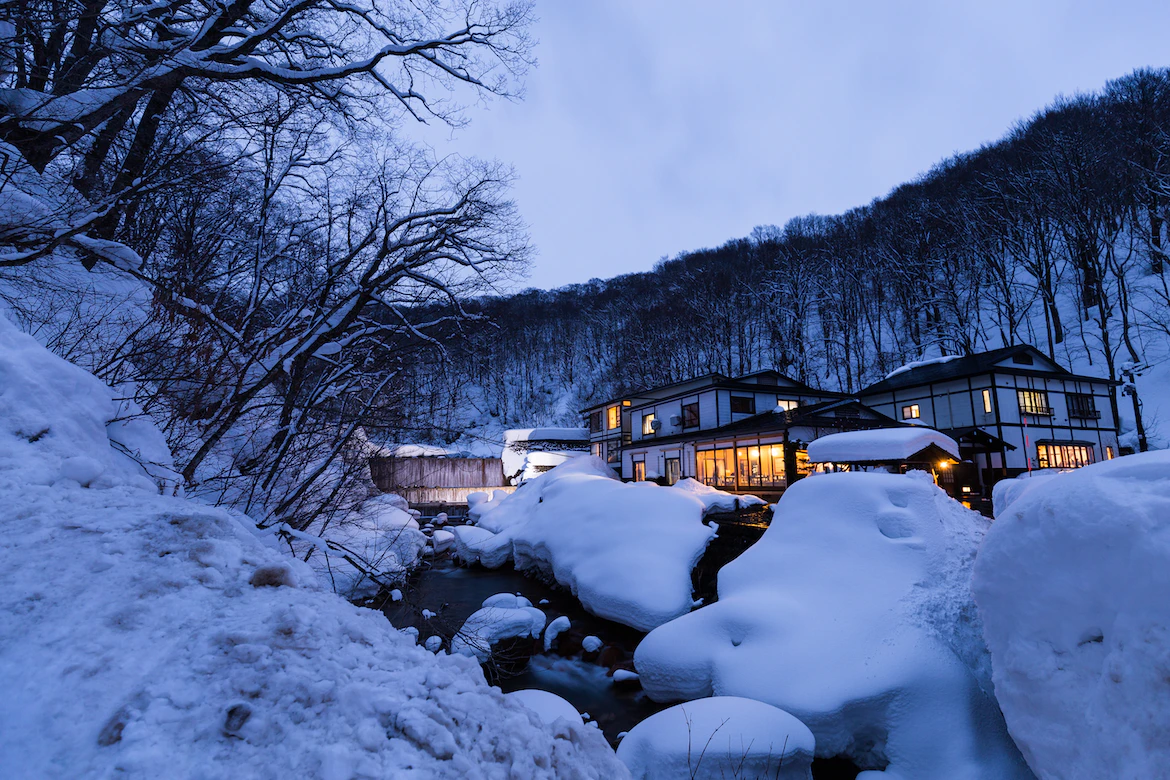
Akita is far enough north that winter defines it. Snow piles to the second floor, the nights are long, and the culture that grew up here is shaped by both—fierce festivals, deep hot springs, and traditions kept alive precisely because the rest of Japan rarely comes this way. This is the Tohoku that the Tokyo–Kyoto crowds never see, and the distance is exactly what has preserved it.
It’s a prefecture of strong, specific images: demons that visit homes on New Year’s Eve, a samurai town with its original residences still standing, milky hot springs steaming against the snow, and the most famous loyal dog in the world. Here’s how to read Akita.
Oga Peninsula: Land of the Namahage
The Oga Peninsula is rugged coast and folklore. It’s the home of the Namahage—ogre-like figures who, on New Year’s Eve, visit homes to frighten away laziness and bad fortune, bellowing “Are there any crybabies here?” It sounds quaint until you see it performed; it’s genuinely intense.
- Namahage Museum & Oga Shinzan Folklore Museum — see over 150 distinct village masks, then watch a live reenactment of a Namahage bursting into a traditional house next door. The single best cultural experience in the prefecture.
- Cape Nyudozaki — the peninsula’s northern tip, with sweeping Sea of Japan views where green grassland meets blue water.
- Godzilla Rock — a natural formation that genuinely looks like the kaiju roaring at the sea; best at sunset.
Kakunodate: The Samurai Town That’s Actually Real
Kakunodate is one of the best-preserved samurai districts in Japan, and what sets it apart is authenticity: many of the samurai residences (bukeyashiki) are original, not reproductions, and some are still lived in by descendants of the original families.
- Samurai District — wide streets lined with weeping cherry trees (shidarezakura). In late April it’s one of Japan’s finest cherry blossom spots.
- Aoyagi House — a sprawling samurai estate turned museum, full of antique weapons, tools, and art.
- A rickshaw ride through the streets adds the atmosphere, with a guide who knows the history.
Nyuto Onsen: Hot Springs Frozen in Time
Deep in Towada-Hachimantai National Park, Nyuto Onsenkyo is a cluster of seven traditional hot-spring inns that feel untouched by the modern world.
- Tsurunoyu — the oldest and most famous, with milky-white sulfur water, thatched-roof buildings, and a mixed-gender open-air bath that’s iconic surrounded by winter snow.
- Staying overnight means kaiseki dinners of mountain vegetables (sansai) and river fish, futons on tatami, and soaking under the stars. Day visits are possible, but the quiet magic is in the overnight stay.
Odate: Meet the Akita Dog
Odate City is the birthplace of the Akita Inu, the breed made world-famous by Hachiko, the dog that waited years at Shibuya Station for an owner who had died.
- Akita Dog Visitor Center, near Odate Station, lets you learn the breed’s history and meet real Akita dogs in person.
- The Akita Dog Museum, run by the preservation society, goes deeper for serious enthusiasts.
Lake Tazawa and Mount Chokai
- Lake Tazawa — Japan’s deepest lake, a sapphire blue so deep it never freezes, even in the hardest winter. On its shore stands the golden statue of Tatsuko, a girl who, by legend, became a dragon to keep her beauty forever.
- Mount Chokai — the symmetrical “Akita Fuji,” green in summer and white in winter, with rewarding hikes and Sea of Japan views.
Eat This
- Kiritanpo nabe — Akita’s signature: fresh rice mashed, molded around cedar skewers, grilled, then simmered in a hot pot with chicken and vegetables.
- Hinai jidori — one of Japan’s three great heritage chickens, firm and deeply flavored; superb in oyakodon.
- Inaniwa udon — hand-stretched noodles, thinner and silkier than ordinary udon; an elegant lunch.
- Sake — Akita is a premier sake region thanks to pure water and quality rice; look for Aramasa or Yuki no Bosha.
Local Tips Most Visitors Miss
- Time it to a festival if you can — the Kanto Festival (Aug 3–6), where performers balance towering poles of lanterns on their hips and foreheads, and the Yokote Kamakura snow-hut festival in February.
- Rent a car. Trains link the cities, but the best of Akita—Nyuto Onsen, Oga—is far easier by car.
- Stay overnight at Nyuto, don’t day-trip it; the silence after dark is the point.
- Carry cash for rural ryokan and small shops.
- Kakunodate blooms late (late April)—useful cherry-blossom insurance if you missed the south.
Practical Info
| Item | Detail |
|---|---|
| Access | ~4 hr from Tokyo on the Akita Shinkansen (Komachi); covered by the JR Pass |
| Don’t miss | Namahage at Oga, Kakunodate samurai streets, Nyuto Onsen, Lake Tazawa |
| Eat | Kiritanpo nabe, Hinai jidori chicken, Inaniwa udon, local sake |
| Best time | Late April (Kakunodate blossoms), August (Kanto Festival), February (snow festivals) |
| Getting around | Rental car recommended for onsen and Oga |
Akita is northern Japan with the volume turned to its extremes—demons at the door, snow to the eaves, hot springs steaming in the white, and a dog whose loyalty became a national symbol. It takes four hours and a willingness to go where the crowds don’t. That’s the whole reward.