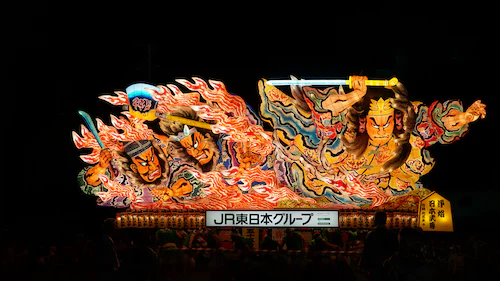
Aomori sits at the very top of Honshu, the last prefecture before Hokkaido, and that location defines everything about it: long, snow-buried winters, a short and explosive summer, and a culture that pours its energy into a handful of intense seasonal moments. The most famous is the Nebuta Festival, when the dark northern nights fill with enormous illuminated paper warriors and the whole city moves to taiko drums. If you want to understand Tohoku—the deep, rural north that most foreign visitors never reach—Aomori is the place to start.
It’s far. That’s the point. The distance is the filter that keeps Aomori authentic, its festivals for locals, its food unspoiled, its mountains empty.
Nebuta: The Reason to Time Your Trip to Early August
The Nebuta Festival (August 2–7) is one of Japan’s great festivals and unlike anything in the tourist-trodden south. Giant lantern floats—warriors, gods, and demons built from painted washi paper over wire frames, lit from within—are paraded through Aomori City at night, surrounded by costumed haneto dancers chanting “rassera, rassera.” You can rent a haneto costume and join the dance; participation is welcomed, not just watching.
If your trip can flex, build it around these dates. The energy is the opposite of the quiet, restrained Japan most visitors expect, and it’s unforgettable.
The Nature: Lake Towada and Oirase Gorge
Inland, Aomori holds some of the most beautiful scenery in northern Japan. Lake Towada is a deep, still crater lake ringed by forest, and from it flows the Oirase Gorge—a stream valley laced with waterfalls and mossy rapids, with a walking path running beside the water. It is spectacular in autumn, when the maples turn, and serene in early summer green.
Further west, Shirakami-Sanchi is a UNESCO World Heritage site protecting one of the last great virgin beech forests in East Asia—deep wilderness with guided trails.
Hirosaki: Cherry Blossoms at a Real Castle
Hirosaki holds one of Japan’s finest cherry blossom displays. Its park surrounds one of the country’s few original castle keeps, and in late April—the blossoms come a month later this far north—thousands of trees bloom around the moats, petals carpeting the water in pink. Because it blooms after the rest of Japan, Hirosaki is the place to catch cherry blossoms if you mistimed them elsewhere.
Mount Iwaki, the “Fuji of Tsugaru,” rises symmetrically over the plain nearby.
Eat This
- Oma tuna—the town of Oma, at Honshu’s northernmost tip, lands the most prized bluefin tuna in Japan; a single fish here has sold for record prices. Eat it where it’s caught.
- Aomori apples—the prefecture grows the bulk of Japan’s apples; try them fresh, as pie, juice, even cider.
- Scallops and squid from the cold local waters.
- Senbei-jiru—a warming hot-pot with rice crackers simmered in the broth, a Tohoku winter staple.
Local Tips Most Visitors Miss
- Plan around Nebuta (Aug 2–7) if you can—it transforms the trip.
- Hirosaki blooms late (late April), your cherry-blossom insurance if you missed the south.
- Reach it by Shinkansen—about 3 hours from Tokyo to Shin-Aomori; it’s farther than people assume but fully connected.
- Rent a car for the lakes and forests—Towada, Oirase, and Shirakami are awkward by public transport.
- Winter is serious snow country—beautiful but cold; pack accordingly and consider the onsen.
Practical Info
| Item | Detail |
|---|---|
| Access | ~3 hr from Tokyo to Shin-Aomori by Tohoku Shinkansen; Aomori Airport for flights |
| Don’t miss | Nebuta Festival (Aug 2–7), Lake Towada, Oirase Gorge, Hirosaki Castle in spring |
| Eat | Oma tuna, Aomori apples, scallops, senbei-jiru |
| Best time | Early August (Nebuta), late April (Hirosaki blossoms), October (Oirase foliage) |
| Getting around | Rental car recommended for nature areas |
Aomori is Japan’s far north distilled: a few weeks of fierce festival light against a long winter, mountains and lakes almost no foreign visitor sees, and the country’s best tuna and apples. Go the distance—it’s the reason the place still feels real.