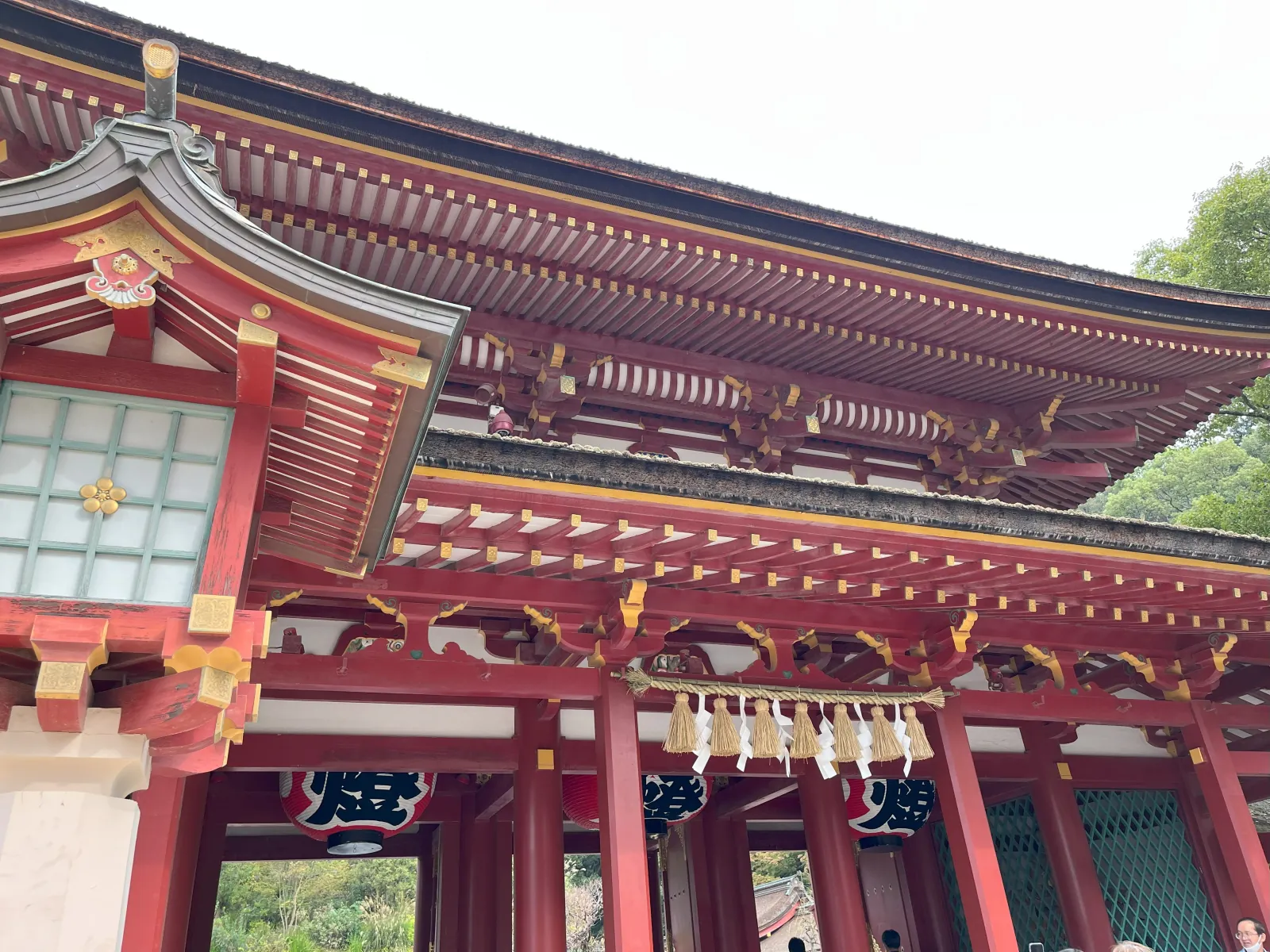
Every major shrine in Japan has a story that explains why it exists in a specific place. Most of these stories involve geography, mythology, or imperial decree. Dazaifu Tenmangu has something rarer: a specific, historically documented human being whose life ended in a way that the Japanese have spent eleven centuries trying to understand and to honor.
That person is Sugawara no Michizane (菅原道真), a scholar and court official of the late Heian period who rose to one of the highest positions in the imperial government, was destroyed by political rivals, sent into exile to Dazaifu—then a remote administrative outpost in Kyushu—and died there in 903 AD, in circumstances that his contemporaries described as death from grief and humiliation. His deification followed shortly afterward.
To visit Dazaifu Tenmangu without knowing this story is to visit a beautiful shrine with a plum orchard and warm rice cakes and miss the entire reason it is here.
The Man Behind the Deity: Sugawara no Michizane
Michizane was born in 845 AD into a family with a tradition of scholarship but not of high political power. He rose through the Heian imperial court by ability rather than lineage—a distinction that made him unusual and, ultimately, dangerous. By 894 he had achieved the position of Minister of the Right, effectively the second-highest position in the government behind the Emperor.
His downfall was engineered by the Fujiwara clan, who dominated Heian court politics through their strategy of marrying daughters into the imperial family and monopolizing appointments through family networks. Michizane’s rise through merit disrupted this arrangement. In 901, the Fujiwara fabricated accusations of disloyalty against him—the specific charges are historically unclear, which suggests they were either too vague to record accurately or too clearly fabricated to commit to paper—and had him exiled to Dazaifu as the Deputy Governor of Kyushu.
The position sounds administrative. In practice, it was a form of exile to the administrative fringe of the country. He was stripped of his court ranks, separated from his family, and given a post that carried no real power and was understood by everyone as punishment. He arrived in Dazaifu in 901 and died there in 903, at the age of 58. Contemporary accounts describe him as having refused adequate food and shelter in his grief; whether this represents a deliberate choice or the conditions of his exile is unclear from the records.
The deification happened quickly and dramatically. Within decades of his death, a series of calamities struck Kyoto: lightning bolts killed several Fujiwara officials and their associates, floods destroyed key court buildings, a plague followed. The court interpreted these events as evidence of Michizane’s vengeful spirit (onryo)—a concept in Shinto and Buddhist belief whereby a person who dies with profound unresolved grievance can return as a destructive force. To placate him, his court ranks were posthumously restored, his exile was declared null, and shrines were built in his honor, with Dazaifu Tenmangu constructed over the site of his grave.
He was deified as Tenjin (天神), and in this form he became the patron deity of scholarship, learning, and academic achievement. This is why Japanese students, parents, and teachers make pilgrimages to Tenjin shrines before university entrance examinations. The deity they are addressing is a real person who died of a broken heart in Dazaifu eleven centuries ago.
The Flying Plum: What the Tree in the Inner Sanctuary Means
In the inner precinct of the shrine, immediately to the right of the main hall, stands a single plum tree known as the Tobiume (飛梅)—the Flying Plum. According to the legend associated with Michizane’s exile, he composed a farewell poem to the plum tree in his Kyoto garden before departing for Dazaifu:
Kochi fukaba nioi okoseyo ume no hana / aruji nashi tote haru na wasure so When the east wind blows, send me your fragrance, plum blossoms / do not forget spring even though your master is gone
The tree, according to the legend, was so devoted to its master that it uprooted itself overnight and flew to Dazaifu to be near him. The Tobiume is the tree you see today in the inner precinct. It is said to bloom earlier than the other plum trees in the shrine’s extensive plum orchard—a detail that, whether by genuine horticultural variation or by management, has remained consistently noted in records going back several centuries.
The plum blossom (ume) is inseparable from the Dazaifu experience. The shrine’s orchard contains approximately 6,000 plum trees of 200 varieties. Peak bloom is typically in late January and February, when the combination of white and pink flowers, the old-growth trees, and the wooden architecture of the inner precinct produces a visual density that explains why this is one of the most photographed shrine complexes in Kyushu.
The Main Hall: Architecture and Worship
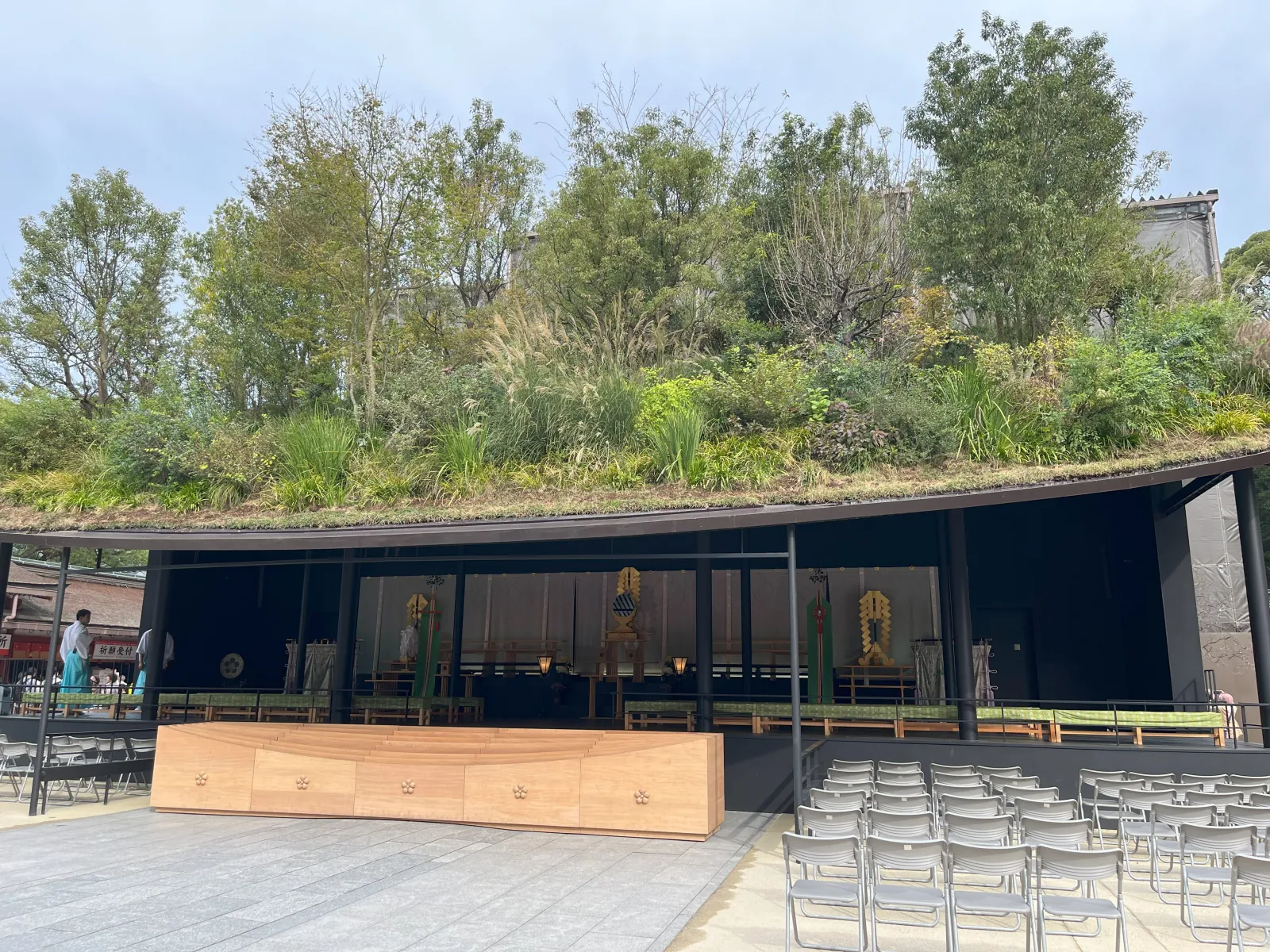
The main hall (honden) of Dazaifu Tenmangu was built, according to tradition, directly over the site of Michizane’s grave. The current structure dates from 1591—built during the Sengoku (Warring States) period under the patronage of the Kobayakawa clan—and has been maintained and repaired continuously since. The architectural style is gongen-zukuri, a distinctive Japanese shrine form characterized by an internal corridor connecting the worship hall and the main sanctuary, which are placed under a single continuous roof.
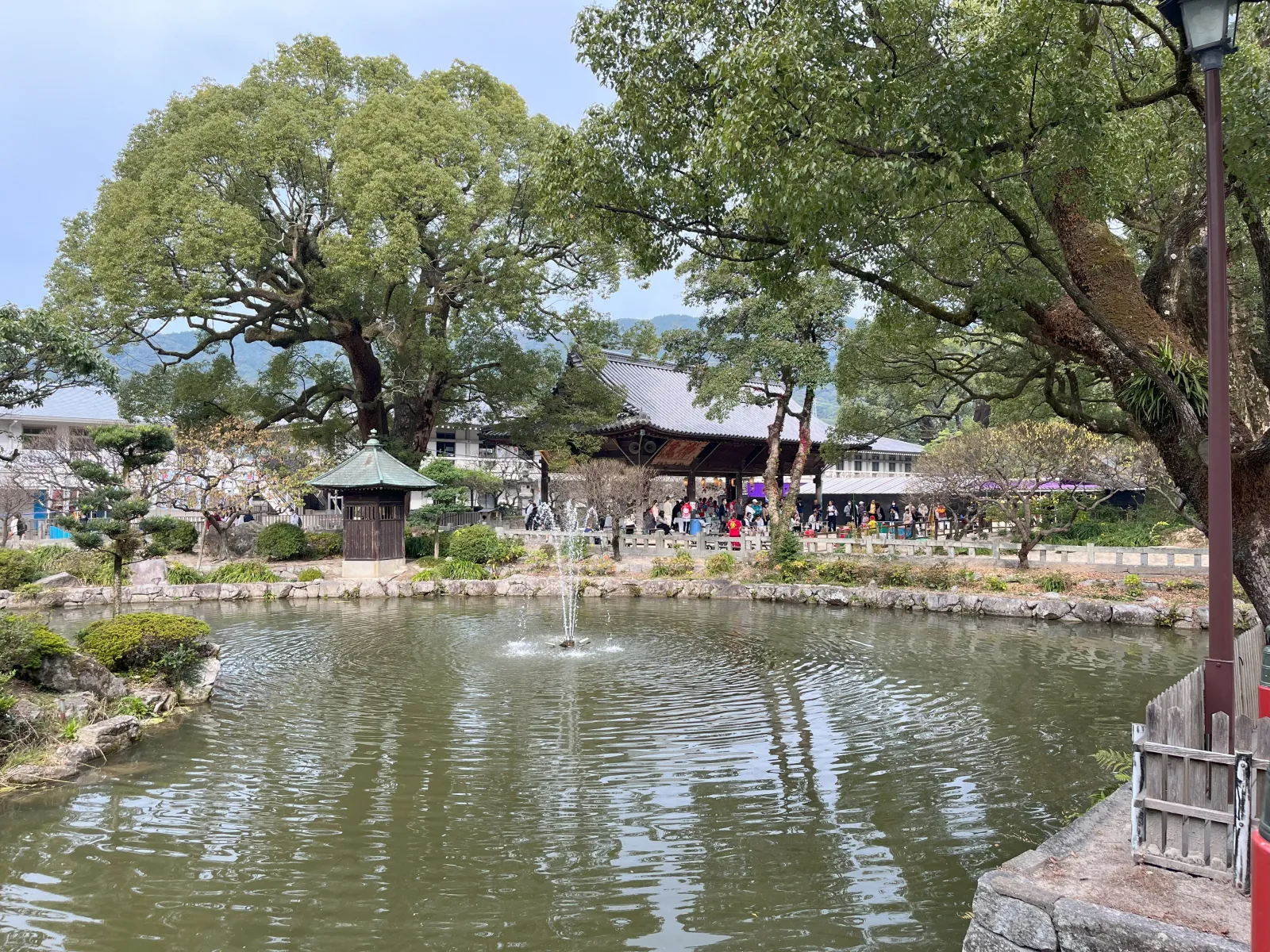
The shrine is approached across two distinctive arched bridges over the Taisho-ike pond, whose layout—two arched bridges connected by a flat central section—is interpreted as representing past, present, and future, with the visitor moving through time as they approach the deity. This interpretation may be retrospective rather than original to the design, but it is the one that shrine guides and signage now provide, and it frames the approach in a way that the purely aesthetic experience of the curved bridges and their water reflections does not.
Worship at the main hall follows the same protocol as most major shrines: coin offering, two bows, two claps, one bow, silent prayer or intention. The specific content of worship here is most commonly academic success (gokaku kigan), and the ema (wooden votive tablets) hung in the precinct are dense with university entrance exam prayers from students across Japan. This continues year-round but peaks in January and February, before entrance exam season.
Umegae Mochi: The Correct Way to Eat One
The approach street (sando) leading to the shrine is lined with shops selling umegae-mochi (梅ヶ枝餅)—small round rice cakes filled with sweet red bean paste, pressed with a plum-blossom stamp, and grilled on a flat griddle until lightly crisp on the outside and warm and soft inside.
The name derives from the “ume-no-eda” (plum branch) that Michizane is said to have used to stir his soup in exile, or alternately from a legend in which an old woman brought him rice cakes on a plum branch. Both stories connect the food directly to the historical figure, which is unusual for a shrine food and explains why it is treated here with more reverence than a snack typically receives.
The practical point: buy one directly from a stall with a visible griddle and eat it immediately, standing. The griddle-fresh texture—lightly crisp exterior, warm and yielding interior, with the bean paste just soft enough to be distinct—is only present for a few minutes after cooking. Cold umegae-mochi from a packaged display at a gift shop is not the same food.
The Approach: Starbucks as Architecture
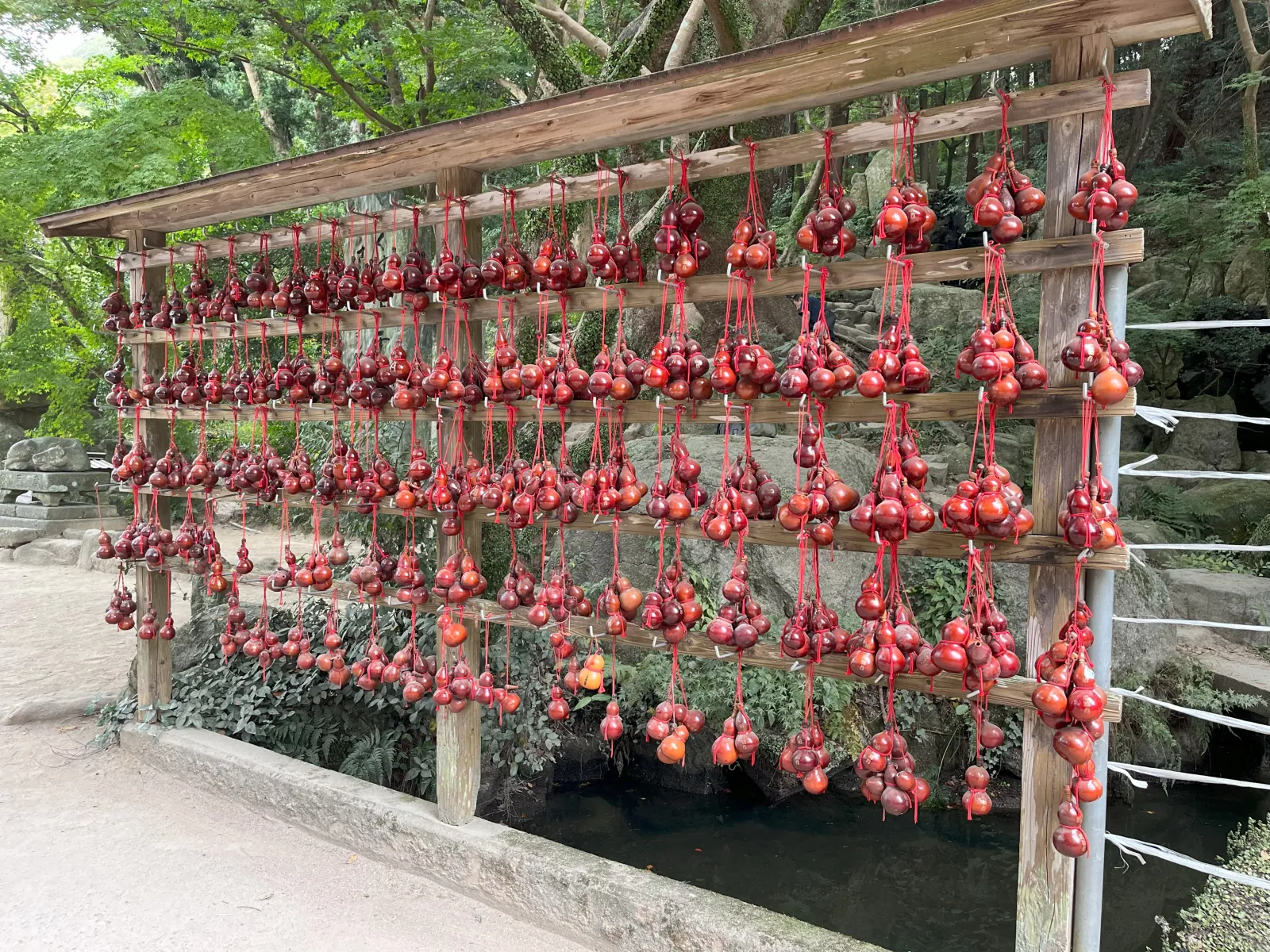
Among the approach street’s shops, one building stands in sharp formal contrast to the others: a Starbucks designed by architect Kengo Kuma, opened in 2011. The building’s facade consists of approximately 2,000 pieces of wood interlocked in a complex lattice pattern without nails—a traditional Japanese joinery technique (kumiki) applied at architectural scale. The interior extends the lattice structure inward, creating an effect that reads simultaneously as contemporary and deeply traditional.
The building became an international reference point for Starbucks’ practice of commissioning local architectural responses to significant cultural sites. Whether you consume coffee there or not, the building is worth spending five minutes looking at from the street, then walking through the interior to understand how the lattice structure manages light.
Kyushu National Museum: The Fourth National Museum
Kyushu National Museum (九州国立博物館) stands behind the shrine, reached via an escalator tunnel that runs through the hillside—an engineering choice that managed the topography while preserving the visual approach to the shrine from interruption. The museum, opened in 2005, is the fourth national museum in Japan (after Tokyo, Kyoto, and Nara) and the only one whose permanent collection focuses on Japan’s cultural history specifically through its relationship with Asia.
This curatorial framework makes the Kyushu National Museum distinctively complementary to the others: where the Tokyo National Museum covers Japanese art history comprehensively, the Kyushu museum specifically addresses the routes of cultural exchange—trade goods, religious objects, artworks—that connected Japan to China, Korea, and Southeast Asia through the Hakata port over a period of two thousand years.
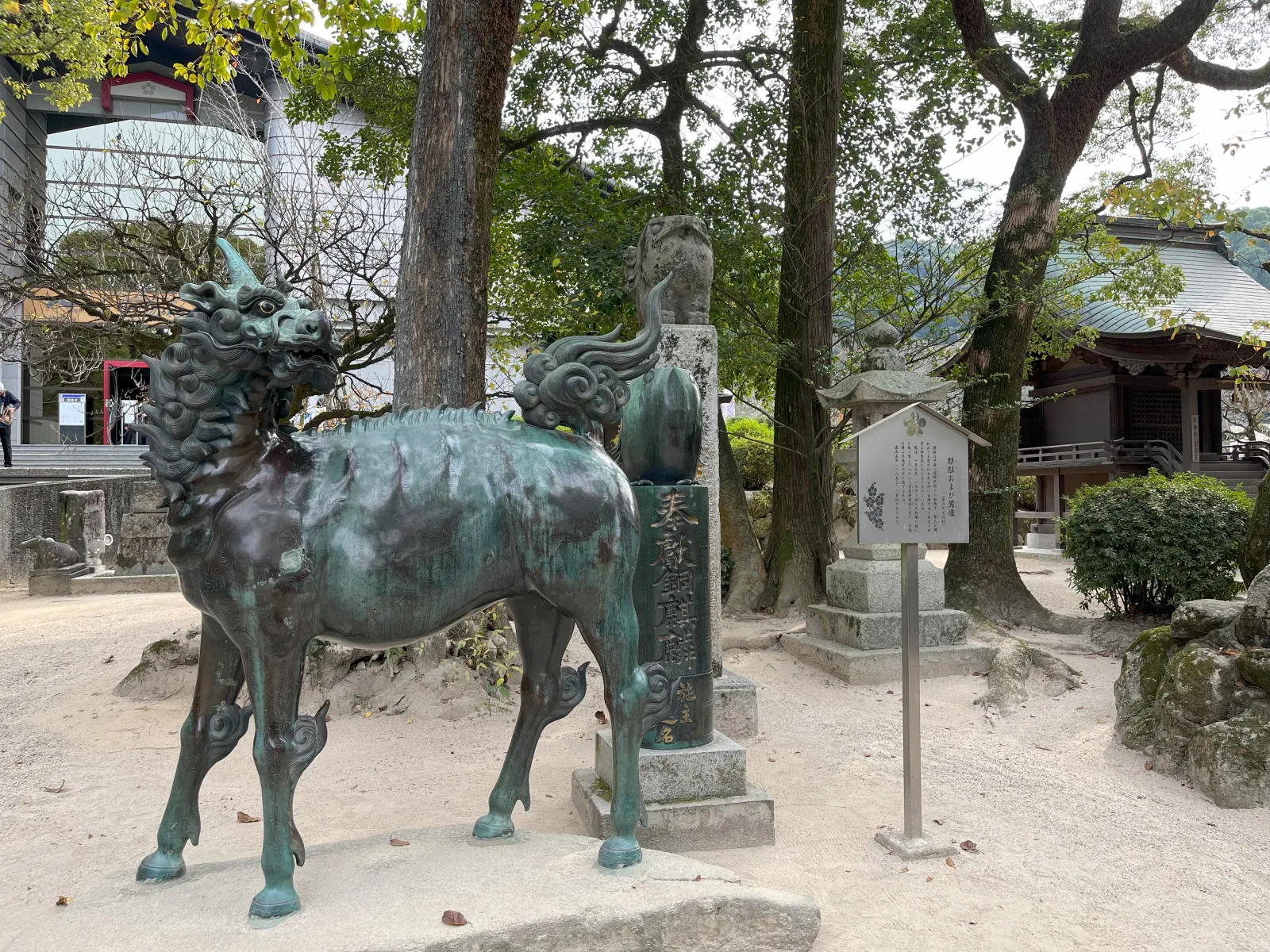
The permanent collection is organized as a chronological walk through these exchange relationships, from prehistoric continental pottery influences through the medieval maritime trade period to the Edo-era formal trade restrictions. The special exhibition galleries host rotating shows that draw from the museum’s extensive holdings and from international loans.
Admission to the permanent collection is ¥700 for adults. Allow 90 minutes to two hours.
Practical Information
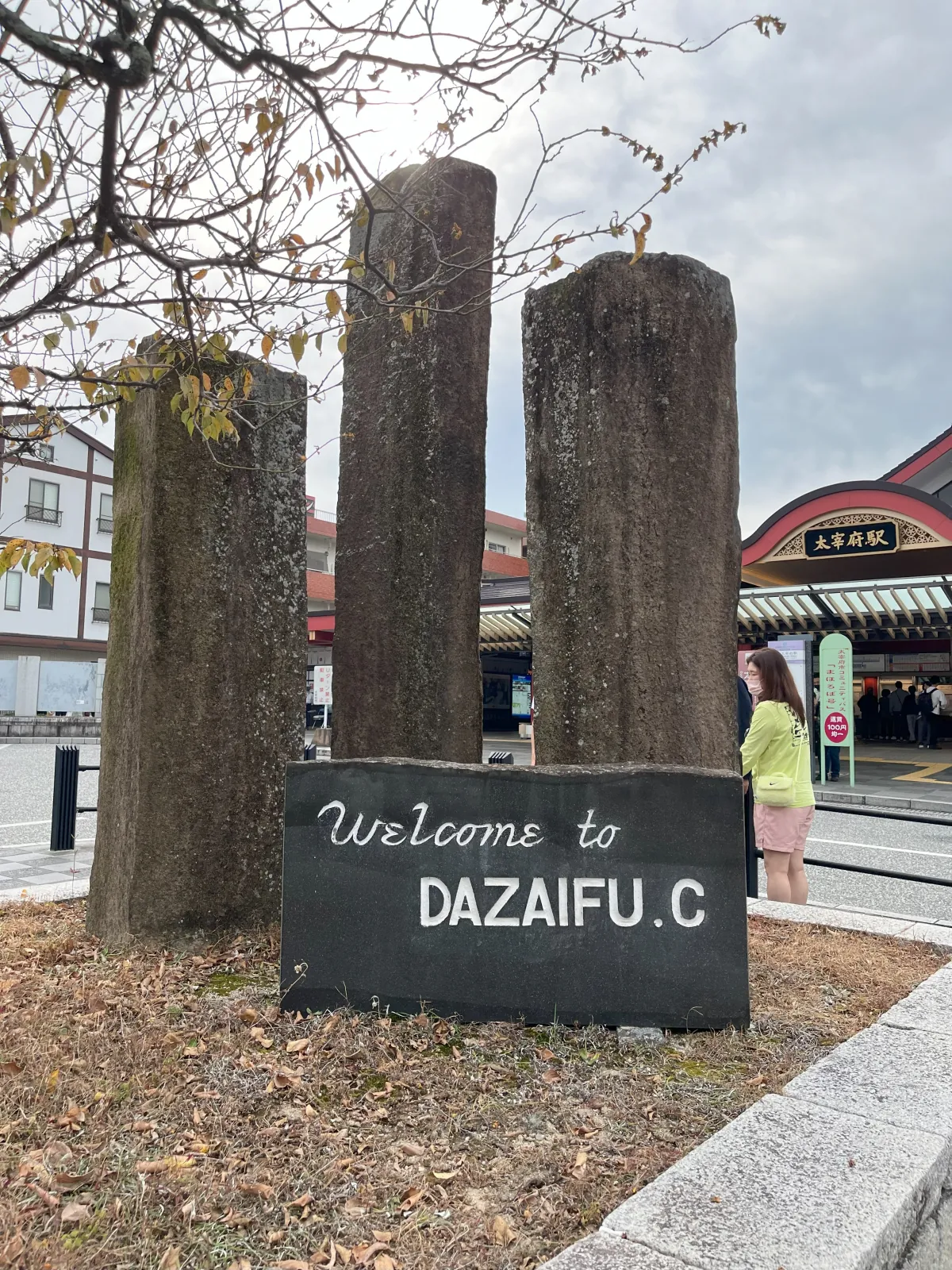
- Access: From Hakata Station, take the Nishitetsu Tenjin Omuta Line from Tenjin Station (one stop by private railway, then transfer) to Dazaifu Station; approximately 40 minutes total. Alternatively, a direct bus from Hakata Station in approximately 35 minutes
- Shrine grounds: Open 24 hours; main hall office 6:30 AM – 7:00 PM
- Admission: Free for shrine grounds; the Treasure House (homotsuden) is a separate paid entry
- Kyushu National Museum: Tuesday–Sunday, 9:30 AM – 5:00 PM (Fridays and Saturdays until 8:00 PM); ¥700 adults; closed Mondays
- Plum blossom season: Typically late January through mid-February; the shrine website publishes bloom status updates during the season
- Best timing: Weekday mornings for the shrine itself; the approach and main hall are significantly quieter before 10 AM