Fukuoka has a mild reputation problem: it is consistently voted Japan’s most livable city by domestic surveys, praised for its compact geography, its airport that sits inside the city limits, its food, its proximity to Korea and China—and then largely overlooked by foreign visitors doing the standard Tokyo–Kyoto–Osaka circuit.
This is partly because Fukuoka rewards a different mode of travel than Kyoto’s temple-to-temple itinerary or Osaka’s shouting street-food energy. The city’s appeal is structural: the way the Hakata and Tenjin districts relate to each other, the fact that the airport is fifteen minutes from the center by subway, the specific texture of eating at a yatai stall at 10 PM with the Naka River behind you and a bowl of ramen in front of you that has been made by someone whose family has been making it the same way for three generations.
The Geography That Explains Everything
Fukuoka sits at the northwestern tip of Kyushu, facing the Korea Strait. At its closest point, the Korean coastline is approximately 200 kilometers away—closer to Fukuoka than Tokyo is. The nearest Chinese port is roughly the same distance. This geographic reality has shaped the city’s culture, food, and commercial character for over a thousand years.
The ancient Hakata port was one of the primary points of contact between Japan and the Asian continent during the Nara and Heian periods, a conduit for Chinese Tang dynasty culture, Buddhism, and eventually Mongolian invasion fleets. The Mongols came twice—in 1274 and 1281—and both times were repelled, partly by military resistance and partly by typhoons that the Japanese called kamikaze (divine wind). The defensive stone wall built in response to the first invasion is still partially visible in Nishijin district.
This continental orientation explains why Fukuoka has historically felt culturally distinct from the rest of Japan—less deferential to Tokyo’s tastes, more direct in its social style, and deeply invested in its own food traditions in ways that exist independently of the national culinary conversation.
Hakata Ramen: The Dish That Defined a City
Tonkotsu ramen originated in Fukuoka in the 1940s, specifically in the city of Kurume to the south, before the style migrated to Hakata and was refined into what is now recognized globally. The defining characteristics—a milky white broth made from pork bones simmered for hours until the collagen breaks down completely, thin straight noodles, chashu pork, and a restrained set of toppings—are the result of specific choices made by specific people in specific shops, now several generations deep.
The broth’s opacity is the technical signature: tonkotsu requires aggressive high-heat simmering that forces the fat and marrow into emulsification. The result is a broth that is not merely pork-flavored but has a body and depth that lighter-broth ramens cannot replicate. Regulars develop preferences for specific shops based on the ratio of creamy to clear broth, the texture of the noodles, and the intensity of the tare (flavor concentrate). These preferences are held with the quiet conviction of people who have been eating in the same shop since childhood.
The correct approach to tonkotsu ramen at a serious Hakata shop:
- Order the standard bowl first—do not modify
- After the first bowl, order kaedama (a refill of noodles added to your remaining broth, typically for ¥100–¥200)
- Sit at the counter rather than a table when possible
- Leave the toppings provided (sesame seeds, crushed garlic, pickled ginger, spicy mustard greens) on the counter and add them progressively through the bowl
The Yatai: Why This Still Exists Only in Fukuoka
Yatai (屋台)—the portable food stalls that set up at night in public spaces—were once common across Japan. Postwar street food culture produced them in most major cities; city governments gradually regulated them out of existence through the 1970s and 1980s on grounds of sanitation, fire safety, and urban order.
Fukuoka kept them. The approximately 100 yatai operating in the city today are licensed, permitted, and subject to health inspections. Each stall typically seats between six and ten people at a narrow counter under a canvas roof. The menu varies by owner but typically includes ramen, oden (simmered winter ingredients), yakitori, and tori-kawa (crispy grilled chicken skin, a Fukuoka specialty).
The most concentrated yatai areas are:
- Nakasu (the bar island between the Naka and Hakata rivers) — the highest density and the most visually dramatic, with stalls lined along the river bank
- Tenjin (central district, near the Watanabe-dori underpass) — slightly less touristic, preferred by regulars
- Nagahama (near the former wholesale fish market) — the roughest and most authentic, specializing in ramen
Sitting at a yatai has a specific social logic. The counter puts you in immediate proximity to whoever sits down next to you. The owner typically manages the cooking and conversation simultaneously. The correct behavior is to order beer and food, eat and drink, and be present without performing—the same operating principle as a good standing bar in any country. Conversations with the person next to you may or may not happen; this is fine either way.
Yatai operate from roughly 6 PM to midnight or 1 AM. They do not take reservations. In cold weather, kerosene heaters under the canvas produce a warmth that is genuinely cozy; in rain, the canvas keeps most of the water out but not all of it.
Nakasu: The Floating Pleasure District
Nakasu (中洲) is a long narrow island formed by the Naka and Hakata rivers, historically Fukuoka’s entertainment district and now its most concentrated zone of nightlife: yatai along the river edge, karaoke boxes, izakayas, bars, and the kind of establishment that does not require further specification. The island is small enough to walk end to end in fifteen minutes.
Nakasu functions on the principle that entertainment and food coexist without hierarchy. You might eat ramen at a yatai, walk fifty meters to a bar for shochu, walk another thirty meters for a nightcap at a standing sake counter. The density is high and the navigation is done on foot.
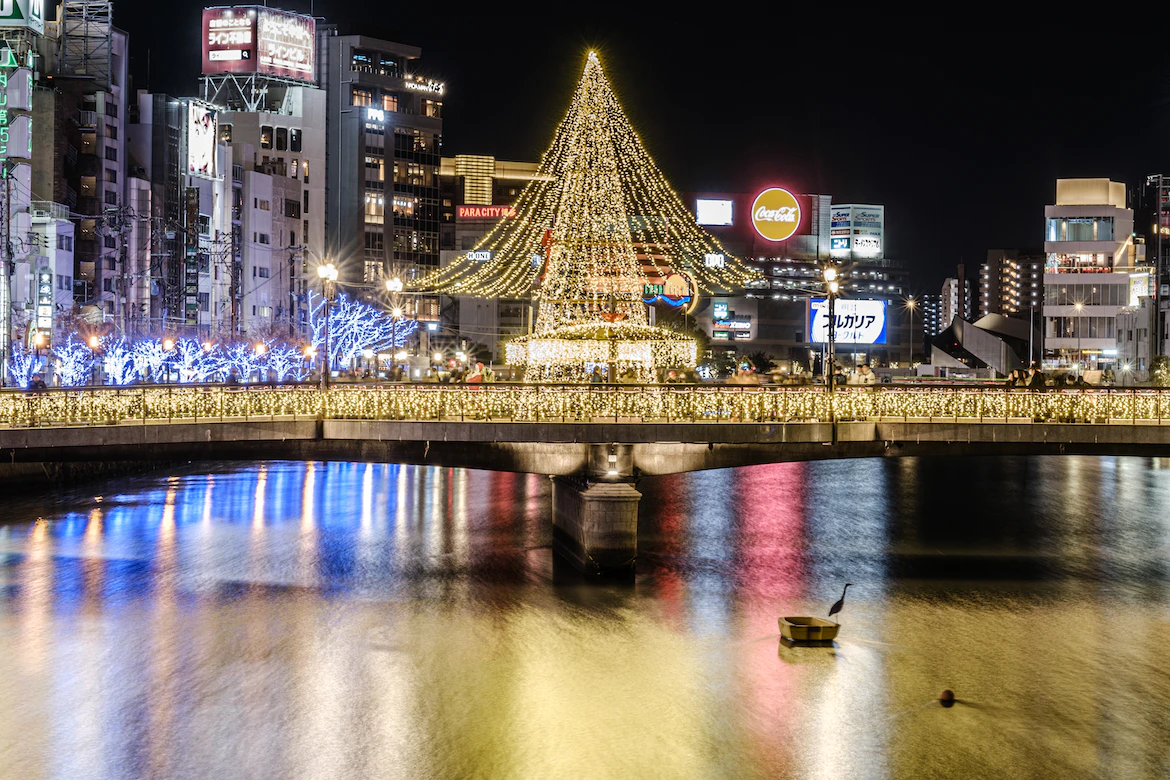
The yatai along the Nakagawa-bori embankment are the most photographed element of Nakasu—a row of glowing canvas stalls with the city lights reflected in the river behind them. This view is genuinely as good as it appears in photographs, particularly in autumn and winter when the air is clear.
Hakata and Tenjin: The Two Centers
Fukuoka operates from two distinct commercial centers that are connected by subway in seven minutes.
Hakata is the historic commercial and transport hub. Hakata Station, the main Shinkansen terminus, generates a gravity that pulls department stores, restaurants, and business hotels into its orbit. The underground shopping complex beneath the station—Hakata Deitos and the connecting corridors—is comprehensive enough to spend a rainy afternoon entirely underground without running out of things to look at or eat.
Tenjin is the fashion and culture center, organized around Tenjin Station and the wide boulevard of Watanabe-dori. The streets between Tenjin and Daimyo (the trendy neighborhood immediately behind it) have a concentration of independent boutiques, cafés, and restaurants that reflects a local rather than visitor-oriented taste. This is the area to explore if you want to see what Fukuoka’s twenty and thirty-year-olds consider interesting.
Canal City Hakata, a large indoor shopping and entertainment complex between the two centers, is distinctive for its architecture—a curved structure built along an artificial canal—and for housing a Ramen Stadium on the fifth floor, where eight ramen restaurants from different regional Japanese styles operate side by side. It is explicitly touristy and worth spending an hour in for the Ramen Stadium alone.
Day Trips: Dazaifu and Beyond
The most important day trip from Fukuoka is Dazaifu, home to Dazaifu Tenmangu shrine and the Kyushu National Museum. Direct access from Hakata Station to Dazaifu Station takes approximately 40 minutes via the Nishitetsu Tenjin Omuta Line. The shrine, the plum orchard, the stall selling warm umegae-mochi, and the Kengo Kuma–designed Starbucks at the entrance to the approach are all within walking distance of the station.
For coastal scenery, Itoshima to the west has become one of the more photogenic coastal districts in Kyushu—a farming and fishing peninsula with rice paddies, oyster farms (operating from November through March), and a low-key restaurant scene that has developed around the local agricultural products. Direct bus and train access from Fukuoka.
Practical Information
- Getting to Fukuoka: Fukuoka Airport is 15 minutes from Hakata Station by subway (Kuko Line); 2 minutes from Domestic Terminal. One of the most convenient airport-to-city connections in Japan
- By Shinkansen: Tokyo to Hakata is approximately 5 hours (Nozomi); Osaka to Hakata is approximately 2.5 hours
- Hakata to Tenjin: 7 minutes by subway (Kuko Line); 15 minutes on foot
- Yatai hours: Generally 6:00 PM – midnight; most do not accept reservations or credit cards; cash required
- Language: English menus are less common here than in Tokyo or Osaka; pointing, phone translation, and willingness to accept the recommendation are the practical tools
- Best season: Autumn (October–November) for weather and food; July–August for the Hakata Gion Yamakasa festival (major Shinto festival with running portable shrines)