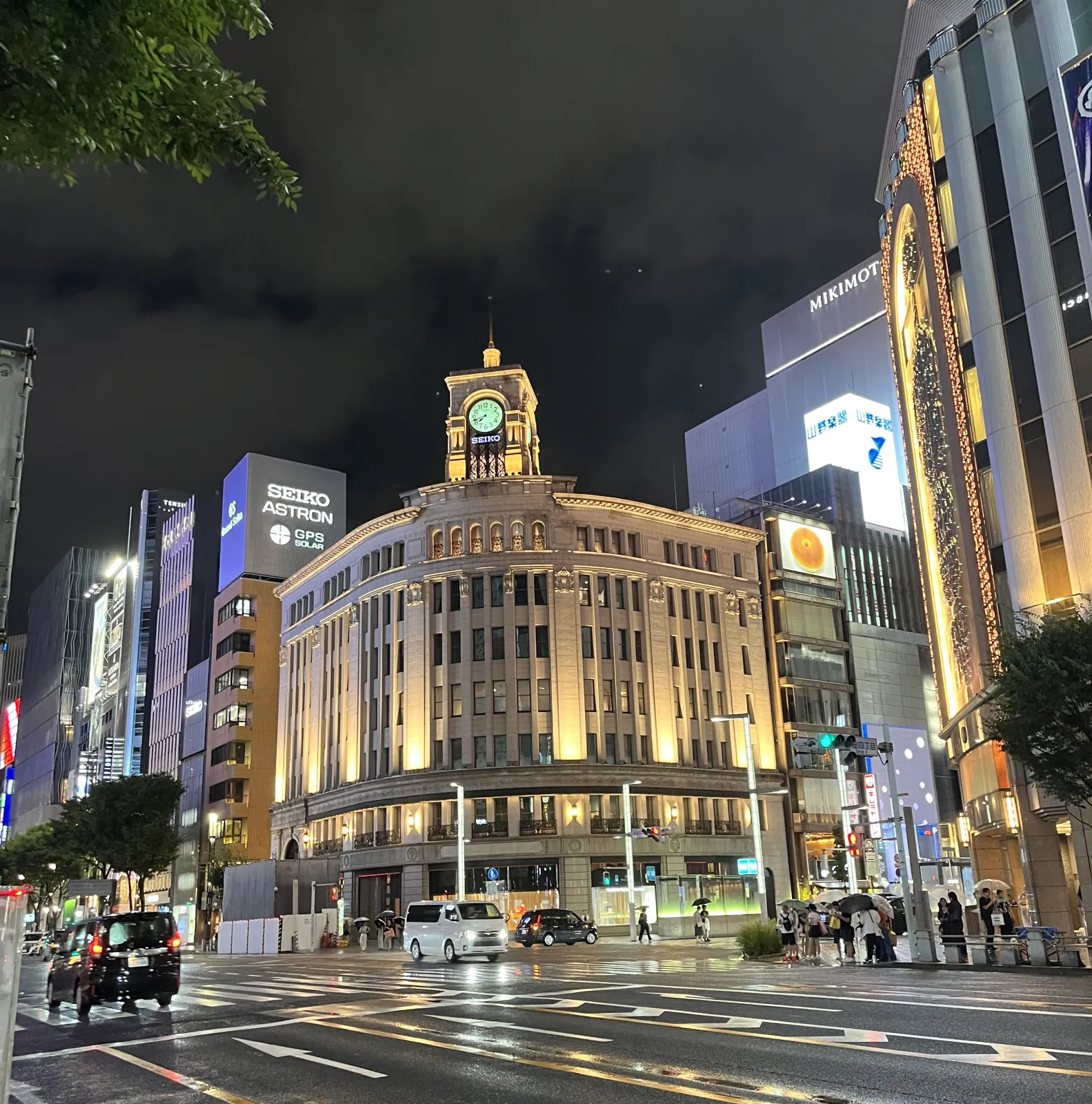
There is a phrase in Japanese—otona no Tokyo (大人の東京), “adult Tokyo”—that gets used when people mean the part of the city that has nothing to prove. Shibuya is always announcing itself. Shinjuku is always scaling. Ginza simply exists, with the quiet confidence of somewhere that has been the most expensive square kilometer in Japan for the better part of a century and expects you to understand why.
The mistake most visitors make is treating Ginza as purely a luxury retail destination—the place to walk past Chanel and Hermès before heading somewhere more affordable. That reading misses what the neighborhood actually offers. Some of Ginza’s best experiences cost nothing, or cost the price of a coffee and a sweet bean bun.
The Weekend Pedestrian Paradise: Ginza on Hokoten
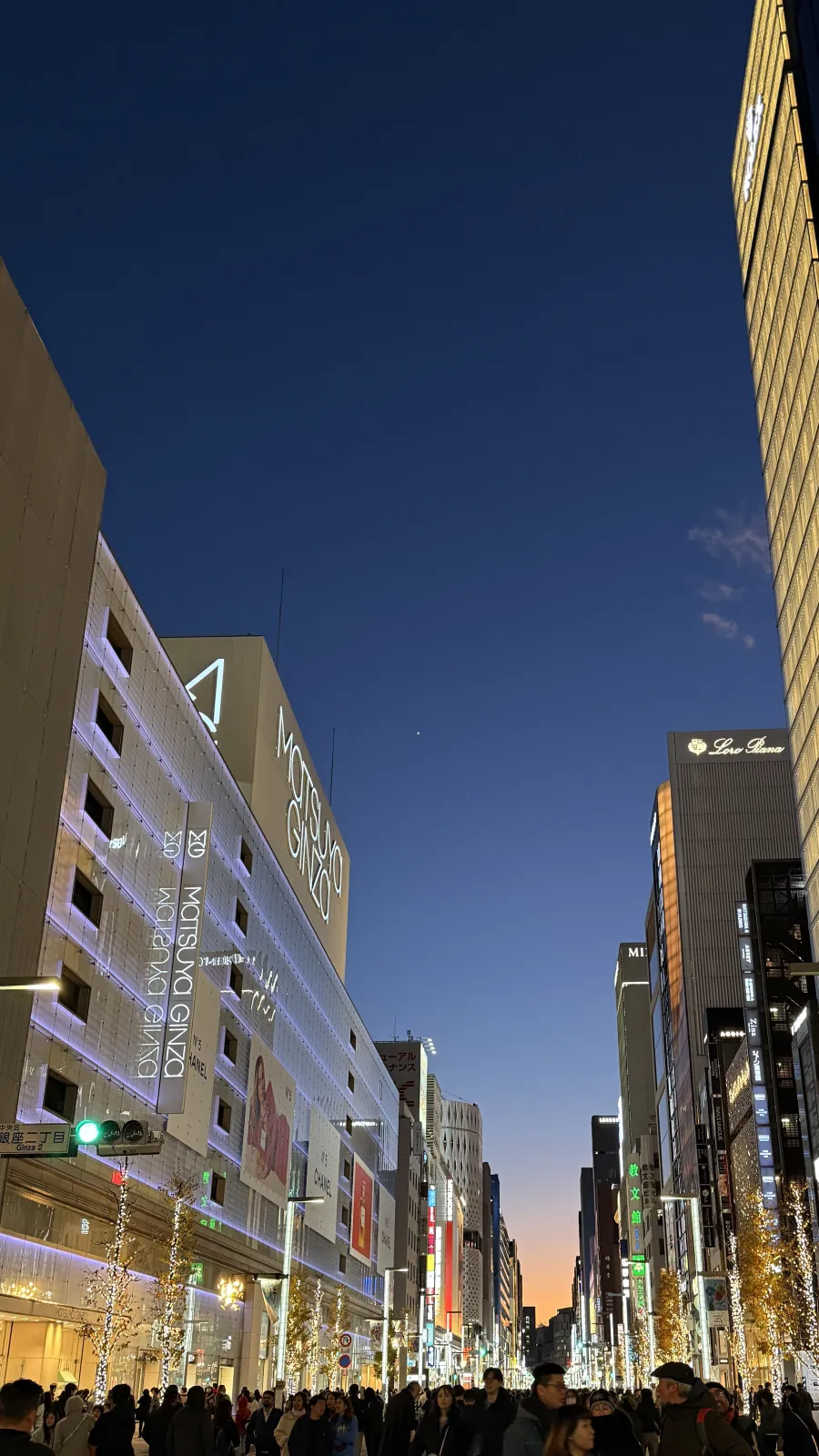
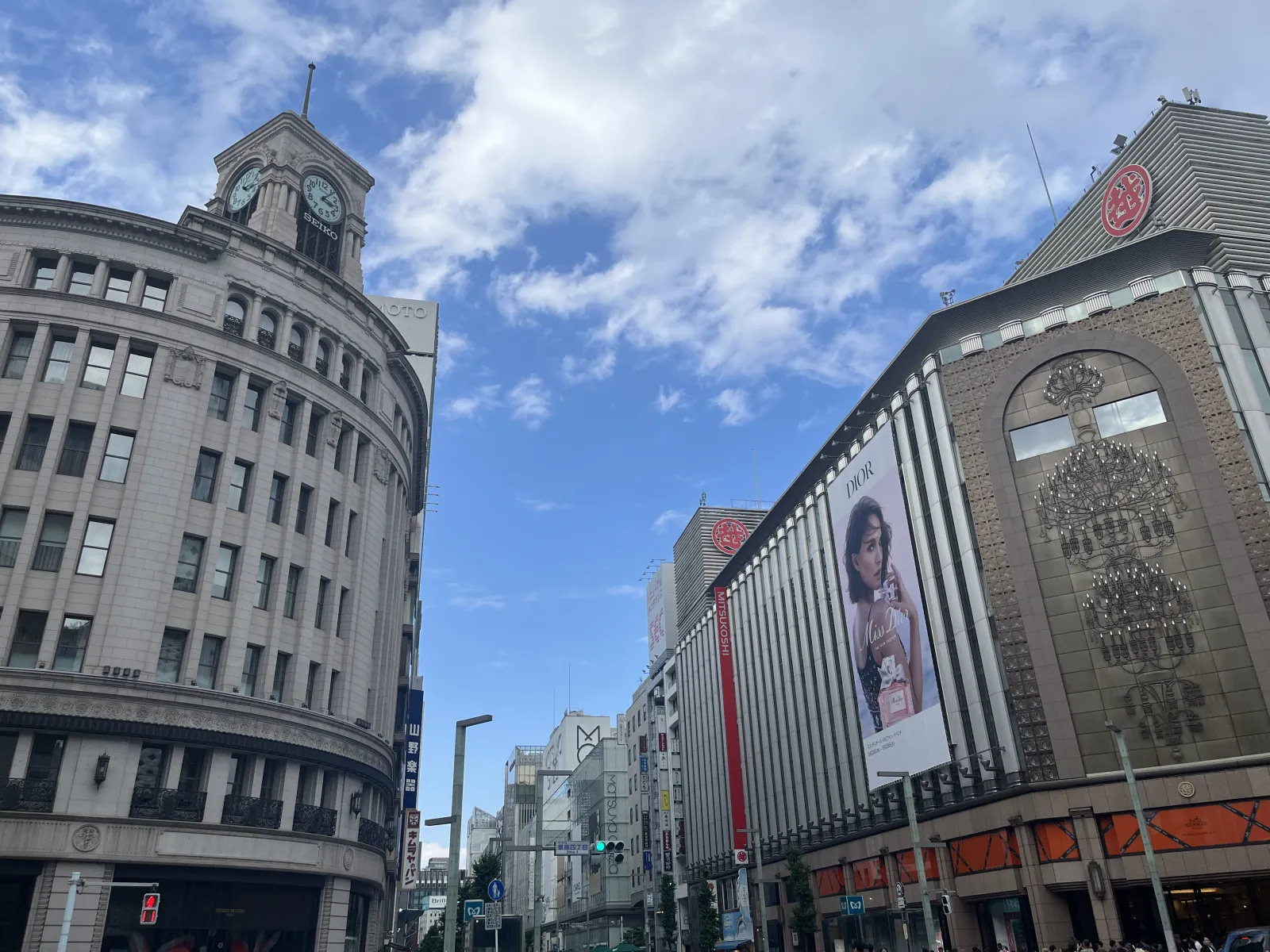
If your schedule allows any flexibility, plan your Ginza visit for a Saturday or Sunday afternoon. Between 12 PM and 6 PM (April through September) or 12 PM to 5 PM (October through March), the main artery Chuo-dori is closed to vehicles and becomes what Tokyoites call hokoten—a pedestrian paradise.
The transformation is complete and slightly surreal. A six-lane road that is ordinarily one of the most traffic-dense in the city becomes a promenade. People walk down the center of what was the road. Children run. Couples stop to take photographs in spots that would be impossible any other day of the week. The buildings—many of them notable architectural works in their own right—are suddenly accessible at walking pace rather than glimpsed through a car window.
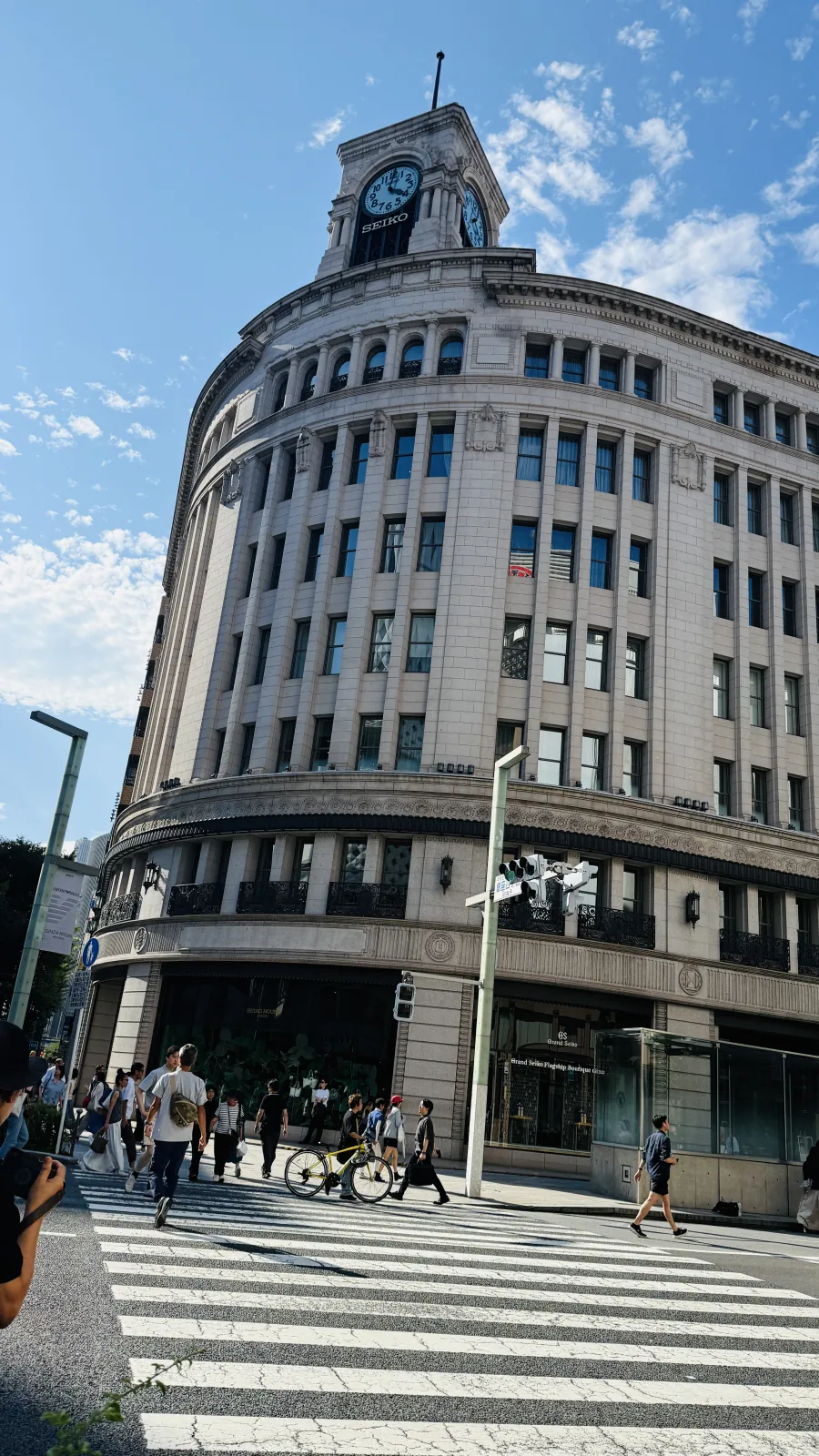
The visual anchor of the hokoten is the Wako Building at the Ginza 4-chome intersection: a limestone building completed in 1932, topped with a clock tower, and surrounded by the four corners of what has historically been the most valuable intersection in Japan. The Wako clock is a Tokyo landmark in the same register as the Skytree or Tokyo Tower—quieter, harder to explain, but deeply embedded in the visual memory of the city.
Stand in the middle of the Chuo-dori at the Wako intersection on a Sunday afternoon. This is, in aggregate, one of the stranger and more satisfying things you can do in Tokyo without spending anything.
The Depachika: Michelin-Level Food Without a Reservation
The most consistently misunderstood thing about Ginza is that it is expensive. Some of it is. But the basement food halls—depachika (デパ地下), a contraction of depāto (department store) and chika (underground)—operate on a completely different logic from the boutiques above them.
The depachika of Ginza Mitsukoshi and Matsuya Ginza are among the most serious food halls in Tokyo. The principle is straightforward: a department store’s food basement is where it stakes its reputation for quality, because food is something customers can evaluate immediately. As a result, the brands that hold counters in these basements are curated with unusual rigor.
What this means practically: you can buy a bento box assembled by a chef whose restaurant in the same building costs ¥30,000 for dinner—for perhaps ¥2,500. You can taste wagashi (traditional Japanese confectionery) from workshops that have been operating for over a century. You can pick up prepared dishes from regional Japanese cuisines—Kyoto obanzai, Kyushu mentaiko, Hokkaido dairy—that would require a domestic flight to obtain at the source.
The recommended approach is to arrive around 5 PM on a weekday, when lunch bentos are marked down and the evening crowd has not yet arrived. Walk the full length of the basement level before committing to anything. Treat it as a tasting museum with a low cost of entry. Then buy whatever two or three things looked most interesting on the circuit.
This is not a budget compromise. It is the way many people who live and work in Ginza actually eat.
The Architecture Walk: Flagship Buildings as Cultural Statements
Ginza’s flagship stores are not simply retail. From the early 2000s onward, major international luxury brands began commissioning significant architects to design their Tokyo buildings, and Ginza became, unintentionally, one of the more interesting collections of contemporary architecture in Japan.
The Hermès Building (designed by Renzo Piano, 2001) on Chuo-dori is a glass-block tower that functions as a lantern at night, the interior light visible through the thick glass squares in a way that changes completely from day to evening. The structure holds an art gallery on the upper floors—Maison Hermès Le Forum—that programs serious contemporary art exhibitions and is free to enter.
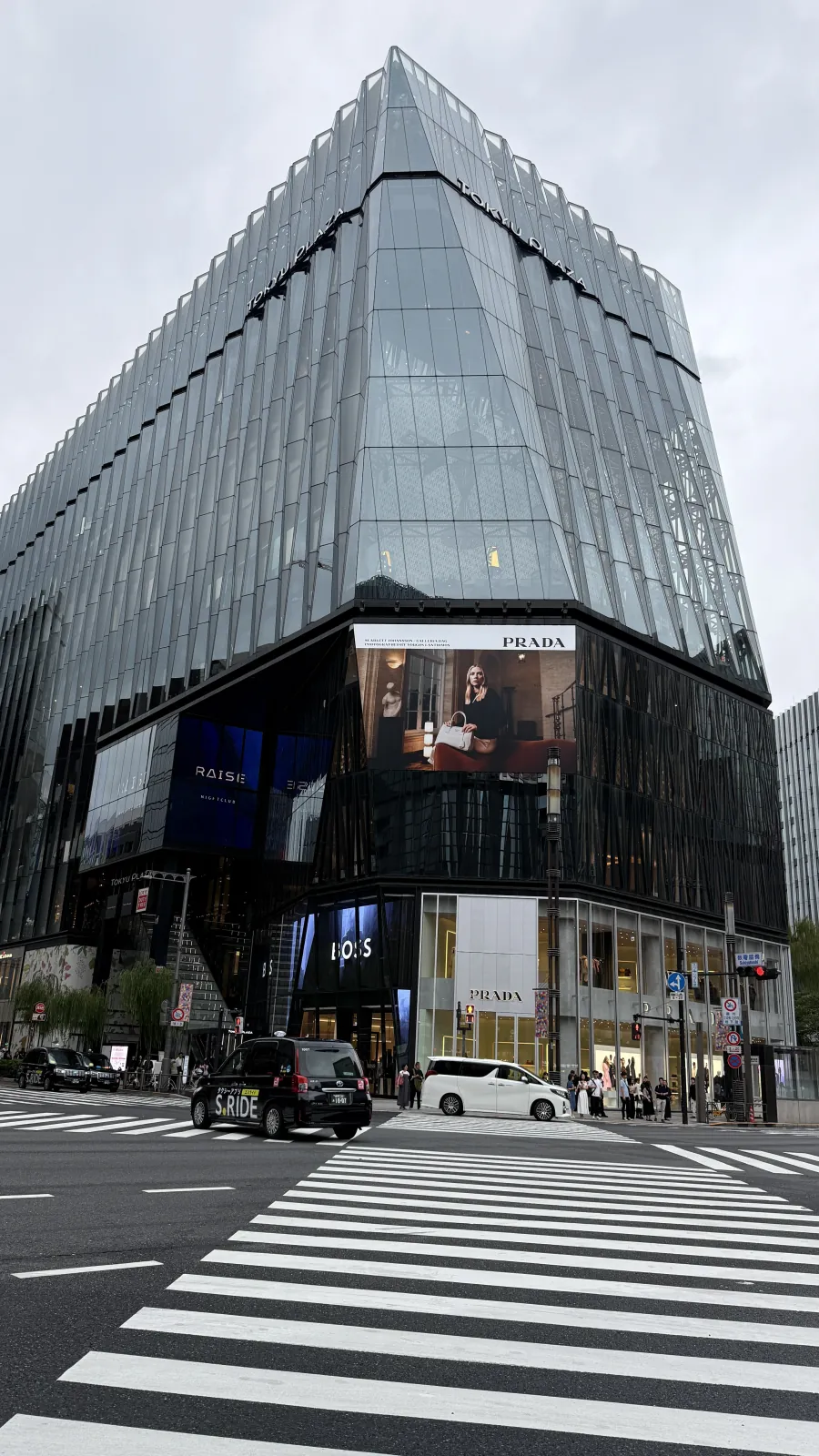
The Prada Building (Herzog & de Meuron, 2003) a few blocks away uses a diamond-grid steel facade and convex and concave glass panels that distort and fracture the reflections of the street. It is visually distinctive from almost every angle and worth a slow walk around the perimeter.
Neither of these buildings requires any interest in fashion to appreciate. They are works of architecture in a neighborhood that has, almost incidentally, assembled a collection of them.
For the broader architectural context: the Wako Building’s clock tower (1932) sits within a five-minute walk of the Hermès and Prada buildings (early 2000s) and several Meiji-era structures that survived the 1923 earthquake. Ginza has been rebuilt in layers across multiple periods, and the current streetscape is a compressed architectural history of modern Japan.
Kabukiza Theatre: One Act Is Enough
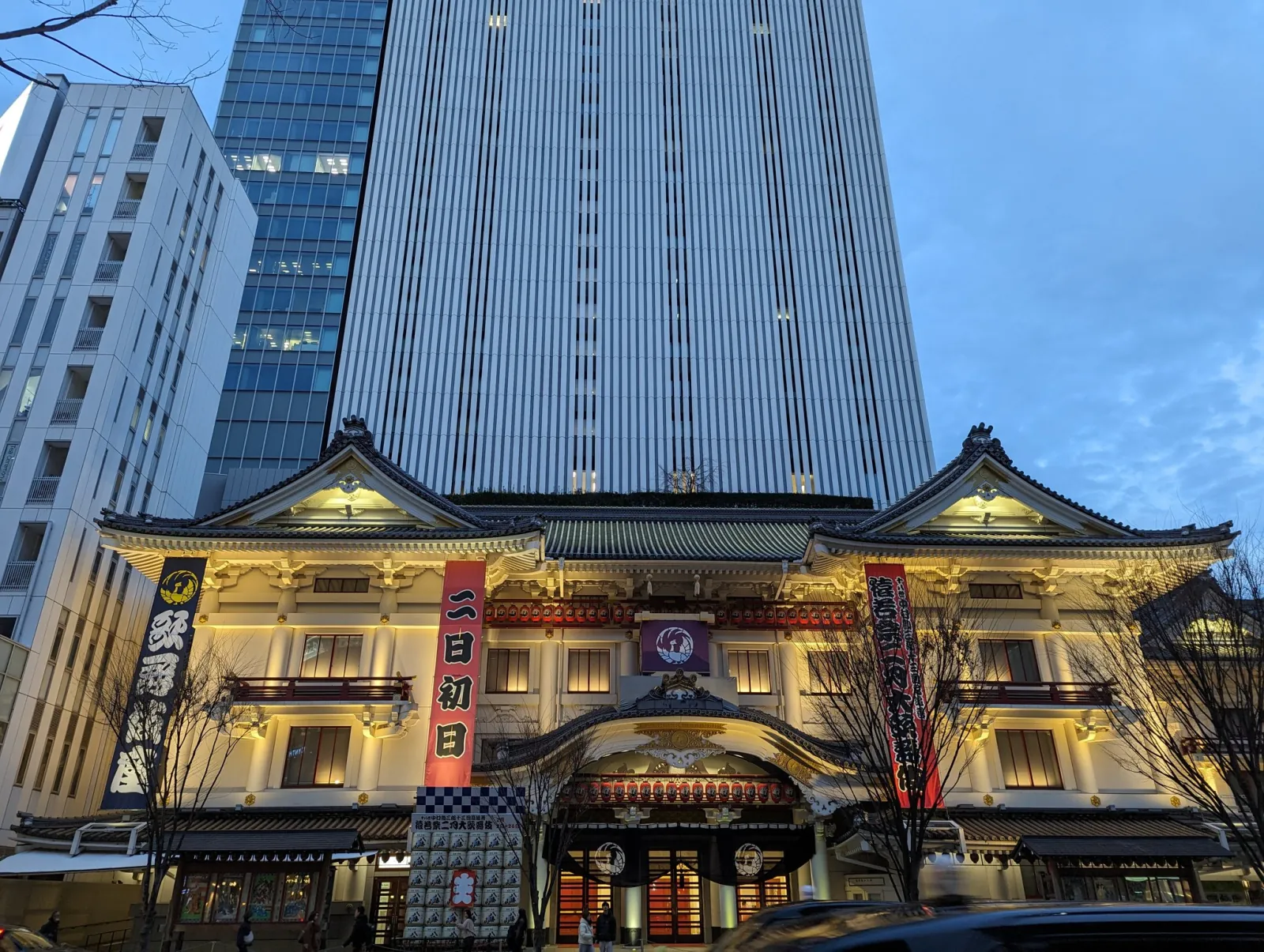
Kabukiza (歌舞伎座) is the main venue for kabuki performance in Tokyo and has stood on the same site in Ginza since 1889, though the current building is its fifth iteration, completed in 2013. The architectural decision to rebuild it in the same early-20th-century Japanese palace style—rather than modernize—was deliberate and mildly controversial at the time. The building now reads as exactly what it is: a statement of cultural continuity in the middle of a neighborhood otherwise defined by the contemporary.
The standard objection to kabuki for foreign visitors is the language barrier. It is a legitimate concern for a full program, which can run four or five hours and assumes familiarity with the stories, character types, and formal conventions that Japanese audience members have absorbed over a lifetime.
The solution is the hitomaku ticket—a single-act admission available at the box office on the day of performance. A single act of kabuki typically runs thirty to sixty minutes. The cost is between ¥1,000 and ¥3,000 depending on the act. What you will understand without language: the mie poses (stylized holds that the audience acknowledges with shouts of the actor’s house name), the hanamichi runway that extends through the audience, the kumadori face makeup that encodes character type through color and line, the otherworldly stylization of the onnagata (male actors playing female roles).
You do not need to understand the dialogue to experience kabuki. You need to be in the room, close enough to see the makeup and hear the shamisen.
The Kissaten Circuit: Coffee Shops That Have Not Changed
Ginza has been home to a particular kind of coffee culture since the Meiji era, when the neighborhood was the primary point of entry for Western influences into Japan. The old-school kissaten—owner-run coffee houses that predate the global café chains by decades—have survived here in higher concentrations than almost anywhere else in Tokyo.
Café de l’Ambre (カフェ・ド・ランブル), on the back streets of Ginza 8-chome, has been operating since 1948 and is one of the oldest functioning coffee houses in Tokyo. The founder, Ichiro Sekiguchi, continued roasting and serving coffee here until his death in 2018 at the age of 102. The shop still runs on his methods, using aged beans—some roasted to his specifications years before serving—and a pour-over approach that treats each cup as a distinct preparation. The interior has not been renovated in any meaningful way since the postwar period. Sitting here costs roughly ¥900 and takes whatever time it takes.
Shiseido Parlour, connected to the cosmetics company of the same name, has been operating a Western-style restaurant in Ginza since 1902. The café on the lower levels serves European-influenced Japanese food at prices that are high but not unreasonable for the context: you are eating in a room that has been in continuous operation for over 120 years, in a building in the middle of the most expensive street in Japan.
Neither of these places requires prior knowledge to enjoy. They require only the willingness to sit still for a period longer than an average restaurant stop.
Japanese Heritage Brands: What to Buy Here That You Cannot Buy Elsewhere
The international luxury boutiques are the visible layer of Ginza retail, but the more interesting shopping—particularly for souvenirs that are genuinely Japanese in origin—is at the heritage brands that have been in the neighborhood for generations.
Itoya (伊東屋), at Ginza 2-chome, is a twelve-story stationery shop that has occupied this location since 1904. The selection of writing paper, notebooks, inks, and pens is comprehensive to the point of being disorienting: multiple floors dedicated to paper type alone, a floor for fountain pens, a floor for art materials. If you are looking for a gift or souvenir that is distinctively Japanese without being a conventional tourist item, this is the reliable choice. A single sheet of washi paper, a bottle of Japanese ink, a Hobonichi planner—any of these travels well and costs between ¥500 and ¥3,000.
Ginza Kimuraya (銀座木村屋), the bakery on Ginza 4-chome, invented anpan—a soft bread roll filled with sweet red bean paste—in 1874, when it was presented to Emperor Meiji as an attempt to create a Japanese-Western hybrid food. The shop still operates at the same location and sells the original recipe alongside seasonal variations. An anpan costs a few hundred yen. It is not remarkable food by current standards. But eating one at the counter on Chuo-dori, knowing that this particular combination of bread and bean paste has been made on this block for 150 years, has a small satisfying historical texture that is harder to find than the price suggests.
When to Come and How Long to Stay
Morning (before 11 AM) is the underrated time slot. The boutiques are not yet open, the streets are quiet, and the neighborhood reveals its residential and commercial side: delivery trucks, men in suits walking quickly, the occasional shopkeeper preparing their window. The Wako intersection at 8 AM has an atmosphere completely unlike its afternoon self. The Shiseido Parlour opens for breakfast and is rarely crowded before 10 AM.
Sunday afternoon is hokoten time, already discussed—the most photogenic and socially legible version of the neighborhood.
Evening (after 7 PM) is when the boutiques close but the restaurants, bars, and remaining kissaten come into their own. Ginza at night is considerably warmer than its daytime reputation suggests: the street is quieter, the lighting changes the character of the architecture, and the people who remain are there to eat and talk rather than to shop.
A thorough Ginza visit takes between three and four hours. A meaningful one—depachika, one building interior, one coffee—takes ninety minutes.
Practical Information
- Access: Ginza Station (Tokyo Metro Ginza, Hibiya, Marunouchi Lines) — direct access to the 4-chome intersection
- Higashi-Ginza Station (Toei Asakusa Line) — closer to Kabukiza Theatre
- Hokoten (pedestrian paradise): Saturday and Sunday, 12:00 PM – 6:00 PM (April–September), 12:00 PM – 5:00 PM (October–March); suspended in rain and on national holidays
- Kabukiza single-act tickets: Available at the box office on the day of performance; arrive 30–40 minutes before the act you wish to see
- Maison Hermès Le Forum: Tuesday–Sunday, 11:00 AM – 7:00 PM; free admission
- Café de l’Ambre: Closed Sundays; opens 12:00 PM on weekdays