Kagurazaka has accumulated several identities over the decades, none of which fully describes it. It is called Tokyo’s French Quarter because the Institut Français du Japon is here and a French community established itself on its slopes after the war. It is called a geisha district because it was one—and a small number of ochaya still operate. It is called a hidden gem, which is what travel guides say when they mean “worth visiting but already discovered.”
None of these labels captures what makes the neighborhood interesting. What makes it interesting is that it developed on a steep hill in a city of mostly flat land, that its winding streets were designed to provide privacy for an entertainment district, and that these same streets—too narrow for large vehicles in many sections, still paved in some places with the stone that geisha walked on—have resisted Tokyo’s standard redevelopment logic simply by virtue of geography.
Walk up from Iidabashi Station and the hill does the work. The noise level drops. The streets narrow. The city recedes.
The Hill and Its History
Kagurazaka (神楽坂) means “Music Slope”—the name references the kagura (sacred Shinto music) performed at Akagi Shrine above the hill. The district developed in the late Edo period primarily as a service neighborhood for the area’s daimyo residences and samurai households, with food stalls, shops, and entertainment establishments clustering around the Bishamonten temple at the top of the slope.
After the Meiji Restoration, as Tokyo’s population grew, Kagurazaka became one of the city’s principal hanamachi (花街)—entertainment districts where geisha hosted clients at ochaya teahouses. The neighborhood’s geography was a significant advantage: the narrow alleys meant guests could arrive and depart discreetly, and the intimate scale created the necessary sense of separation from the city.
At its peak in the Taisho and early Showa periods, Kagurazaka had hundreds of geisha and dozens of active teahouses. The entertainment district contracted after the Second World War as the culture changed, but it never entirely disappeared. Today, a small number of geisha—estimates range between a dozen and several dozen—still work in the neighborhood’s remaining active ochaya, hosting clients at private dinners and traditional performances.
The French connection is more recent. The Institut Français du Japon relocated to Kagurazaka in the 1950s, attracting French diplomatic and academic residents who valued the neighborhood’s European-scale streets and quiet character. The result: French patisseries and bistros that exist because a French community created real demand for French food, not because a developer decided “French would sell well here.”
The Yokocho: Alleys With Designed Purposes
The most distinctive physical feature of Kagurazaka is its network of narrow alleys branching off the main slope. These yokocho (横丁) were not accidental urban development. They were constructed for the geisha district’s specific operational requirements: guests needed routes that were private, the sound of shamisen could not carry to the main street, and the ochaya needed service entrances separate from guest entrances.
Kakurenbo Yokocho (かくれんぼ横丁, “Hide-and-Seek Alley”) is the most photographed: a stone-paved passage so narrow that two people cannot pass side by side, lined by the wooden latticework facades of buildings whose ground-floor uses have changed but whose exteriors remain from the entertainment district era. The name was given in the postwar period; the alleys themselves are Meiji-era construction.
Geisha Shinmichi and the surrounding web of small passages behind the main street retain a density of small restaurants, wine bars, and craft shops in converted machiya (merchant townhouses). These businesses exist because the buildings that house them are too small and oddly shaped for any other commercial use—a direct consequence of the narrow lots created by the alley layout. The geography has protected the district more effectively than any zoning law. You cannot run a construction truck up these alleys. You cannot demolish a building and replace it with a tower without first widening the approach, and widening the approach means demolishing the adjacent buildings, and their owners are not selling.
Bishamonten: The Temple That Anchored the District
Zenkokuji Temple (善国寺), known locally as Bishamonten after the deity it enshrines, has stood near the top of the Kagurazaka slope since 1595. The temple predates the district it now overlooks.
Bishamonten is one of the Seven Lucky Gods and the patron of warriors, financial success, and protection—which is why a temple dedicated to him became the nucleus of an entertainment district. Geisha and the businessmen who entertained clients at their establishments both had reasons to seek his favor.
The temple holds three annual festivals in January, May, and September. The September festival is the occasion for Kagurazaka Awa Odori—a two-day dance festival during which the main slope is closed to traffic and troupes perform the Awa Odori folk dance (originating in Tokushima) along the street. Kagurazaka is one of only two places in Tokyo where Awa Odori is performed on a significant scale, and the combination of the narrow slope, the traditional buildings, and the dance produces something specific to this place.
Akagi Shrine: Kengo Kuma in the Neighborhood
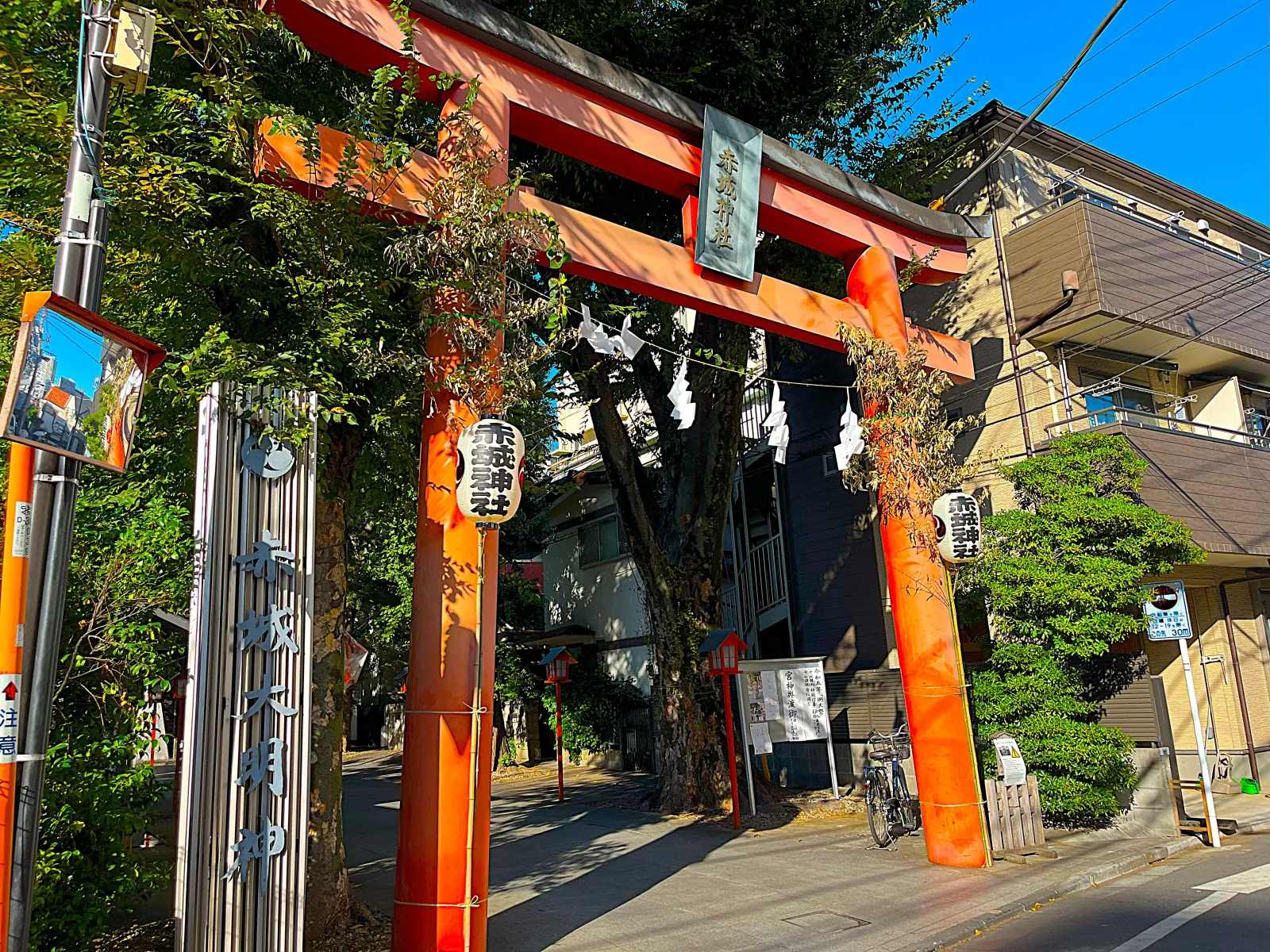
Akagi Shrine (赤城神社) sits above the Bishamonten temple, at the top of the hill. The shrine has been here since the 14th century. In 2010, it underwent a major renovation commissioned in partnership with the Mori Building Company—and the commission went to Kengo Kuma, the architect who also redesigned the Dazaifu Starbucks and later designed the Tokyo 2020 Olympic Stadium.
Kuma replaced the shrine’s postwar concrete structures with a complex of glass, cedar, and steel. The main hall is enclosed in a glass facade through which the timber structure is visible, giving the building a transparency that most traditional shrine architecture deliberately avoids. A commercial building attached to the complex funds the shrine’s maintenance through rental income—an arrangement that the Mori Building Company proposed and the shrine accepted when faced with the cost of renovation.
The result is architecturally significant and formally contested: whether a glass-and-cedar Shinto shrine with a commercial building attached is appropriate is debated. What is not debated: in a neighborhood defined by Meiji-era stone alleys and wooden machiya facades, the Akagi Shrine is a startling object, and it rewards attention.
Eating in Kagurazaka
The neighborhood’s restaurant density is exceptional for its geographic scale, and the range reflects the layered history.
French: Several patisseries and bistros operate at genuine French quality—not the “French-influenced” category but actual techniques applied to quality ingredients, the product of decades of serving a community that knew the difference. The boulangeries on the side streets off the main slope are the practical expression of cultural presence rather than marketing strategy.
Japanese traditional: Narrow-front restaurants in converted machiya offer kaiseki-influenced seasonal cooking in rooms that seat eight to twelve people. These establishments operate by reservation, have been running for decades, and are precisely the kind of place that requires knowing the neighborhood rather than following tourist maps. The neighborhood associations and local media publish dining guides in Japanese; your hotel concierge can advise.
Street level: During festivals and on weekend afternoons, the stalls on the main slope selling yakitori and taiyaki (fish-shaped cakes filled with sweet bean paste) are the most accessible entry point. These represent the neighborhood’s most continuous culinary tradition—direct descendants of the food stalls that operated here in the Edo period.
Practical Information
- Access: Iidabashi Station (JR Sobu Line, Tokyo Metro Tozai/Namboku/Yurakucho Lines), 2-minute walk to the base of Kagurazaka-dori; or Kagurazaka Station (Tokyo Metro Tozai Line), which deposits you directly on the main slope
- Best approach: On foot from Iidabashi, up the main slope—the gradient frames the neighborhood correctly and the painted shop shutters on the lower section are visible before the shops open
- Bishamonten Temple: Open 9:00 AM–5:00 PM; free entry
- Akagi Shrine: Open dawn to dusk; free entry
- Evening: The alleys and small restaurants are most atmospheric after 6 PM, when lanterns are lit in the yokocho and the slope empties of daytime pedestrian traffic
- Best season: September for the Awa Odori festival; April for cherry blossoms at Akagi Shrine; any clear evening year-round for the yokocho atmosphere
Kagurazaka is a neighborhood that has consistently attracted people—geisha clients in the Meiji era, French diplomats in the postwar years, contemporary diners—who were willing to walk up a hill that inconveniences everyone who doesn’t need to be there. That selective inconvenience is the neighborhood’s defining quality, and its preservation mechanism. The hill keeps out the trucks. The trucks are what flatten everything else.