Okayama sits on the Shinkansen line between Osaka and Hiroshima, and most travelers blow straight through it. That’s their loss. This sunny prefecture on the Seto Inland Sea holds one of Japan’s three great gardens, a handsome black castle, the most photogenic canal town in western Japan, and a back-road cycling route through ancient countryside—plus it’s the mainland gateway to the famous art islands of the Inland Sea. It’s an easy, rewarding stop that far too few visitors make.
The local pitch is simple: break your Osaka–Hiroshima journey here for a day or two and you’ll be glad you did.
Korakuen and the Crow Castle
Korakuen is counted among Japan’s “Three Great Gardens,” and unlike many famous gardens it’s spacious and open—broad lawns, ponds, streams, tea houses, and even a small rice field and tea plantation, designed in the early 1700s for a daimyo to stroll and entertain. It’s beautiful in every season and rarely as crowded as Kyoto’s gardens.
Right beside it stands Okayama Castle, nicknamed the “Crow Castle” for its striking black exterior—a deliberate contrast to Himeji’s “White Heron Castle” not far away. The two make a perfect pairing: garden and fortress, white and black, in a single afternoon.
Kurashiki: The Canal Town
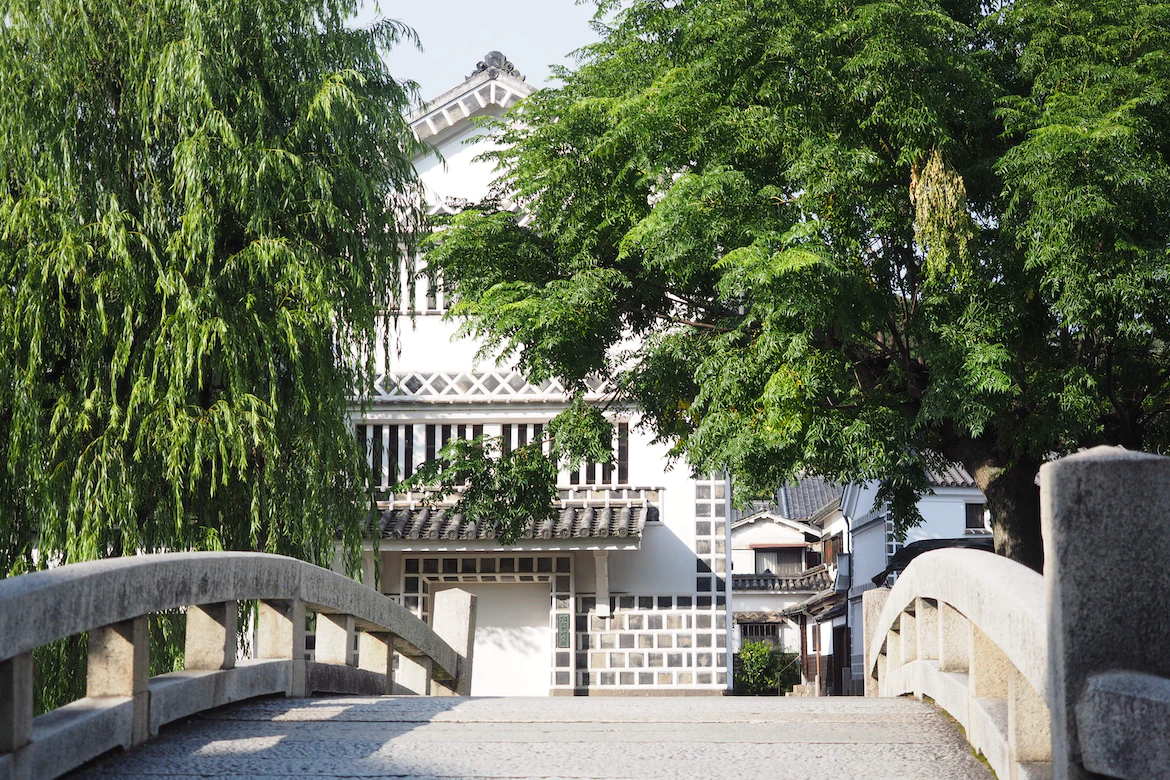
A short train ride away, Kurashiki’s Bikan Historical Quarter is one of the prettiest preserved townscapes in Japan. White-walled Edo-period storehouses line a willow-fringed canal, now home to cafés, craft shops, and museums—including the Ohara Museum of Art, Japan’s first museum of Western art, with real El Grecos and Monets. Glide down the canal in a small boat, and stay until sunset when the old streets glow. Kurashiki is the highlight for many visitors.
The Kibi Plain and the Inland Sea
- Kibi Plain cycling route—a flat, well-marked 15-kilometer path through rural countryside linking ancient shrines, burial mounds, and temples. Rent a bike at one end, return it at the other; it’s one of the most relaxing half-days in western Japan and tied to the legend of Momotaro, the Peach Boy.
- The Seto Inland Sea—Okayama is a mainland gateway to the celebrated art islands (Naoshima and others), reachable by ferry, and to the long Seto Ohashi Bridge linking Honshu to Shikoku.
Eat This
- Okayama fruit—the sunny climate makes this a top producer of white peaches and Muscat grapes; in season, the fruit (and fruit parfaits) are exceptional.
- Bara-zushi—a colorful local scattered-sushi dish.
- Kibi dango—small sweet rice dumplings tied to the Momotaro legend, the classic souvenir.
Local Tips Most Visitors Miss
- Break your Osaka–Hiroshima trip here—Okayama is right on the Shinkansen line and easy to slot in.
- Pair the garden and castle—they’re side by side; do both in one afternoon.
- Give Kurashiki an evening—the canal quarter is at its best at sunset, after day-trippers leave.
- Use Okayama as the gateway to Naoshima if you’re doing the Inland Sea art islands.
- Come in peach/Muscat season (summer) if fruit is your thing—it’s a regional point of pride.
Practical Info
| Item | Detail |
|---|---|
| Access | On the Sanyo Shinkansen between Osaka (~45 min) and Hiroshima (~35 min) |
| Don’t miss | Korakuen, Okayama Castle, Kurashiki Bikan quarter, Kibi Plain cycling |
| Eat | White peaches, Muscat grapes, bara-zushi, kibi dango |
| Best time | Spring and autumn; summer for fruit |
| Gateway to | Naoshima and the Seto Inland Sea art islands |
Okayama is the stop most travelers skip and shouldn’t—a great garden, a black castle, a canal town glowing at dusk, and quiet country roads, all on the way between Osaka and Hiroshima. Get off the train; the sunniest corner of western Japan is worth a day.