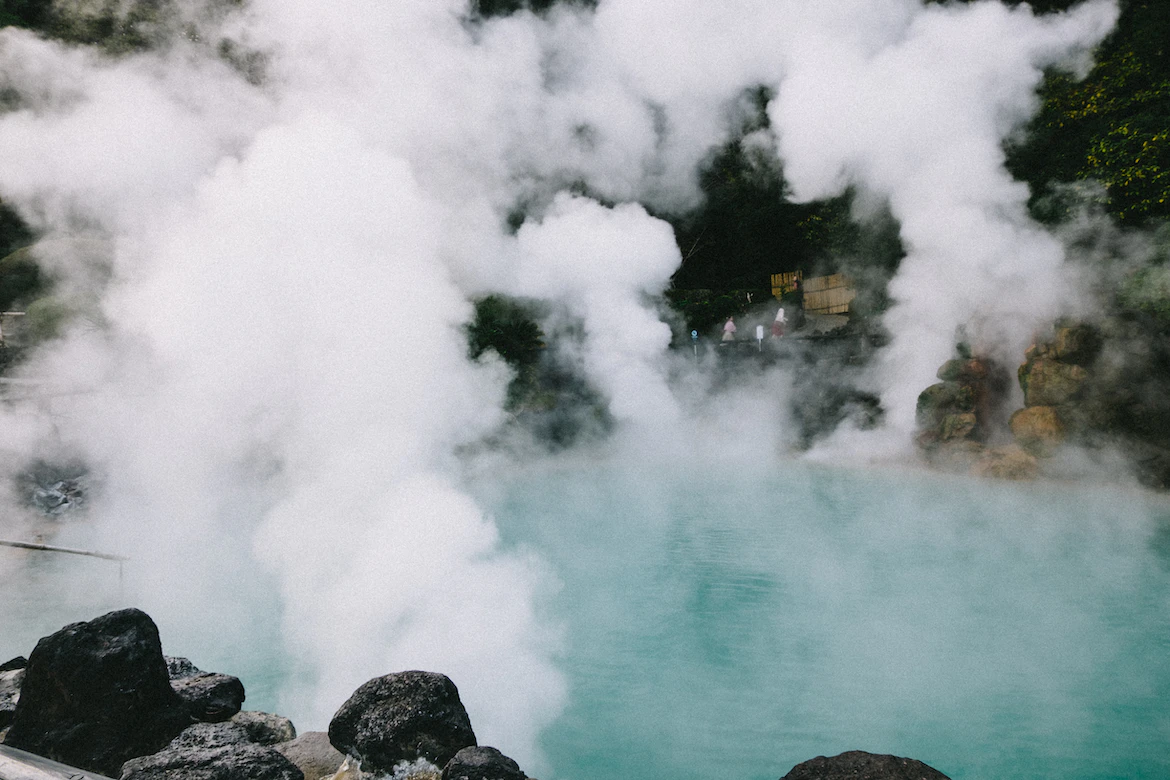
Japan has thousands of hot springs, but only one prefecture where the ground itself seems alive with them. In Oita, on the eastern side of Kyushu, steam rises from drains, from hillsides, from gaps between houses. It produces more hot-spring water than anywhere else in the country, and the city of Beppu alone sits on more than 2,000 sources. If your image of Japan includes soaking in mineral water while snow or steam drifts around you, this is the place that does it at the largest scale.
But Oita is not one kind of onsen town. It splits cleanly into two moods—Beppu’s theatrical, steaming spectacle and Yufuin’s quiet, refined retreat—and choosing between them, or doing both, is how you plan a trip here.
Beppu: The Onsen as Spectacle
Beppu does not whisper. It is a working hot-spring city where steam is part of the skyline, and its signature sight is the Hells of Beppu (Jigoku Meguri)—a circuit of hot springs too hot and too dramatic for bathing, kept instead for viewing. One is a vivid cobalt blue, another a clay-red “blood pond,” another a roaring geyser. They are pure geological theater.
For actual bathing, Beppu offers varieties you will struggle to find elsewhere: sand baths, where attendants bury you up to the neck in naturally heated black sand by the sea, and steam and mud baths in the hillside district of Myoban. After soaking, eat jigoku-mushi—seafood and vegetables steamed in the hot-spring vapor itself, the local cooking method for centuries.
Yufuin: The Onsen as Retreat
Half an hour inland, Yufuin is Beppu’s opposite. A small town spread under the twin peaks of Mount Yufu, it trades spectacle for elegance: a walking street of cafés, craft shops, and small galleries, leading to the still waters of Lake Kinrin, which famously steams in the cool of early morning.
Yufuin is where you book a fine ryokan with a private open-air bath and a multi-course dinner, and do very little else. It draws a domestic crowd precisely because it is calm and tasteful. If Beppu is the show, Yufuin is the rest afterward—and many travelers do one night in each.
Beyond the Hot Springs
Oita rewards anyone who looks past the steam:
- Kunisaki Peninsula—a mountainous, mystical landscape of ancient Buddhist temples, stone Buddhas carved into cliffs, and quiet hiking trails. Visit Futago-ji, deep in the forest.
- Kitsuki—a small, beautifully preserved samurai town where you can rent a kimono and walk between two hilltop former samurai districts.
- Usuki—home to a remarkable group of stone Buddha statues carved into the rock, designated National Treasures.
Eat This
- Toriten—Oita’s beloved chicken tempura, lighter than fried chicken, eaten with citrus-soy.
- Bungo beef—the prefecture’s premium wagyu.
- Kabosu—a fragrant local citrus squeezed over almost everything.
- Jigoku-mushi—anything steamed in the hot-spring vapor at Beppu.
Local Tips Most Visitors Miss
- Do both towns. Beppu for the spectacle and sand baths, Yufuin for the quiet ryokan night—they’re 30 minutes apart and complement each other perfectly.
- Reach it via Fukuoka. Oita pairs naturally with a wider Kyushu trip; it’s about two hours from Fukuoka by train or bus.
- Try a bath you can’t get elsewhere—the Beppu sand bath is worth it for the novelty alone.
- Rent a car for Kunisaki. The peninsula’s temples and stone Buddhas are scattered and hard to reach by public transport.
- Onsen runs year-round, but winter—steam against cold air—is when it feels most magical.
Practical Info
| Item | Detail |
|---|---|
| Access | ~2 hr from Fukuoka by train/bus; Oita Airport for direct flights |
| Two bases | Beppu (spectacle, sand baths) and Yufuin (refined ryokan retreat) |
| Don’t miss | Hells of Beppu, a Beppu sand bath, Lake Kinrin at dawn, Kunisaki temples |
| Eat | Toriten, Bungo beef, jigoku-mushi, kabosu citrus |
| Best time | Year-round; winter for steam-against-cold atmosphere |
Oita is what happens when a place is built on top of the earth’s own heat. Watch the Hells boil, get buried in hot sand by the sea, then retreat to Yufuin for a quiet bath under Mount Yufu—and you’ll see why Japanese travelers treat this corner of Kyushu as the country’s true onsen heartland.