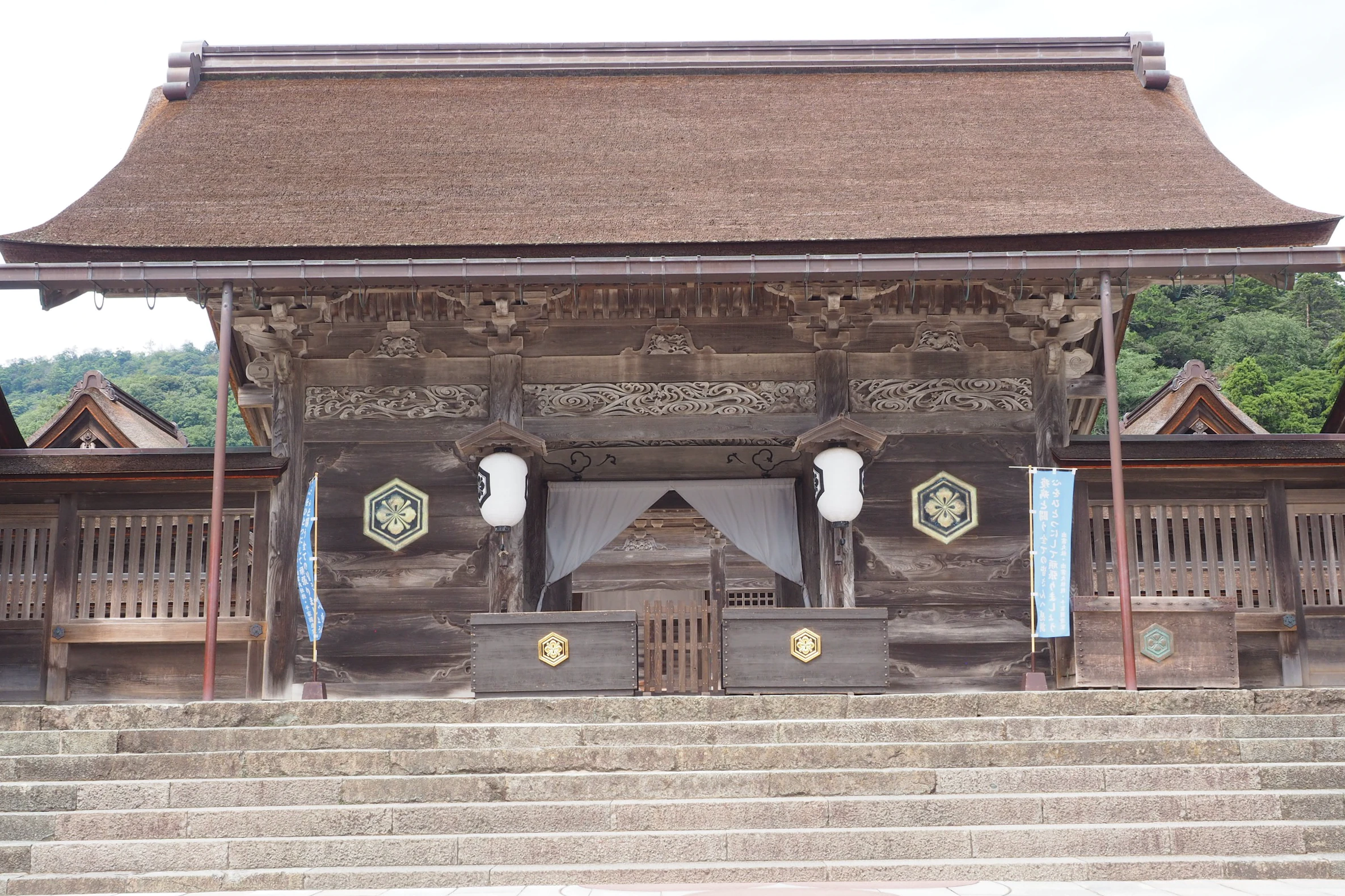
In the old Japanese calendar, the tenth month is called Kannazuki—“the month without gods”—because all eight million Shinto deities are said to leave their shrines and travel somewhere else. In one place, and only one, that same month has a different name: Kamiarizuki, “the month with gods.” That place is Izumo, in Shimane Prefecture, where the gods are believed to gather. This single piece of mythology tells you everything about Shimane’s status in the Japanese imagination: this is where the country’s oldest spiritual roots run deepest.
Shimane is remote, sits on the quiet Sea of Japan coast, and is largely unknown to foreign visitors. That is exactly why it remains one of the most authentically Japanese regions you can travel.
Izumo Taisha: The Shrine of the Gathering Gods
Izumo Taisha is one of the oldest and most important Shinto shrines in Japan—arguably older than even Ise. It is dedicated to Okuninushi, the deity of nation-building and, crucially, of en-musubi—the forging of relationships and good matches. For this reason Japanese people travel here specifically to pray for love and connection.
Two things to understand before you go:
- The enormous shimenawa (sacred straw rope) over the worship hall is among the largest in Japan, a genuinely awe-inspiring object.
- At Izumo, you clap four times instead of the usual two when you pray (two for yourself, two for your partner or wished-for partner). Doing it correctly marks you as someone who understands.
Matsue: The Original Black Castle
The prefectural capital, Matsue, holds one of only twelve original castles left in Japan—structures that survived from the feudal era rather than being later reconstructions. Nicknamed the “Black Castle” for its dark wooden exterior, it’s a rare chance to climb the real thing. From its top floor, views stretch over the city and Lake Shinji.
Matsue is also a city of water, threaded with canals you can tour by boat, and it was the adopted home of Lafcadio Hearn, the Western writer who did more than almost anyone to introduce old Japan to the world. His former residence is preserved here.
Two More Reasons to Make the Trip
The Adachi Museum of Art
The Adachi Museum is famous less for its paintings—though those are excellent—than for its gardens, which have been ranked the best in Japan by a leading garden journal for over two decades running. The genius is that the gardens are designed to be viewed like living paintings, framed through the museum’s windows. You don’t walk in them; you contemplate them. It is a uniquely Japanese idea of beauty, and unforgettable.
Iwami Ginzan: The Silver That Moved the World
Iwami Ginzan is a UNESCO World Heritage silver mine that, at its peak in the 1500s–1600s, produced a remarkable share of the world’s silver and tied this quiet corner of Japan into global trade. You can walk the atmospheric old mining town and venture into the cool mine shafts themselves.
Eat This
- Izumo soba—buckwheat noodles served in distinctive stacked round lacquer dishes (warigo), eaten with the broth poured over.
- Shijimi clams from Lake Shinji—tiny, intensely flavored, classically served in miso soup.
- Lake Shinji sunset—not food, but the lake’s sunset is rated among Japan’s finest; time your evening for it.
Local Tips Most Visitors Miss
- Clap four times at Izumo Taisha, not two—it’s the local custom and tied to the love-and-connection blessing.
- October is special but crowded—the “month with gods” draws pilgrims; go then for atmosphere, or off-season for quiet.
- Catch the Lake Shinji sunset from the Matsue shore; it’s a genuine highlight.
- Rent a car to link Izumo, Matsue, Adachi, and Iwami Ginzan comfortably—public transport is sparse out here.
- Combine with Tottori next door for a fuller San’in coast trip.
Practical Info
| Item | Detail |
|---|---|
| Access | Izumo Airport (flights from Tokyo/Osaka); or limited express trains along the San’in line |
| Don’t miss | Izumo Taisha, Matsue Castle, Adachi Museum gardens, Iwami Ginzan, Lake Shinji sunset |
| Eat | Izumo soba, Lake Shinji shijimi clams |
| Best time | Spring and autumn; October for the “gathering of gods” |
| Getting around | Rental car strongly recommended |
Shimane is where Japan keeps its oldest gods and its quietest beauty—a shrine the deities themselves visit, a real castle, the country’s finest garden, and a silver mine that once touched the whole world. It takes effort to reach, and that effort is the filter that keeps it real.