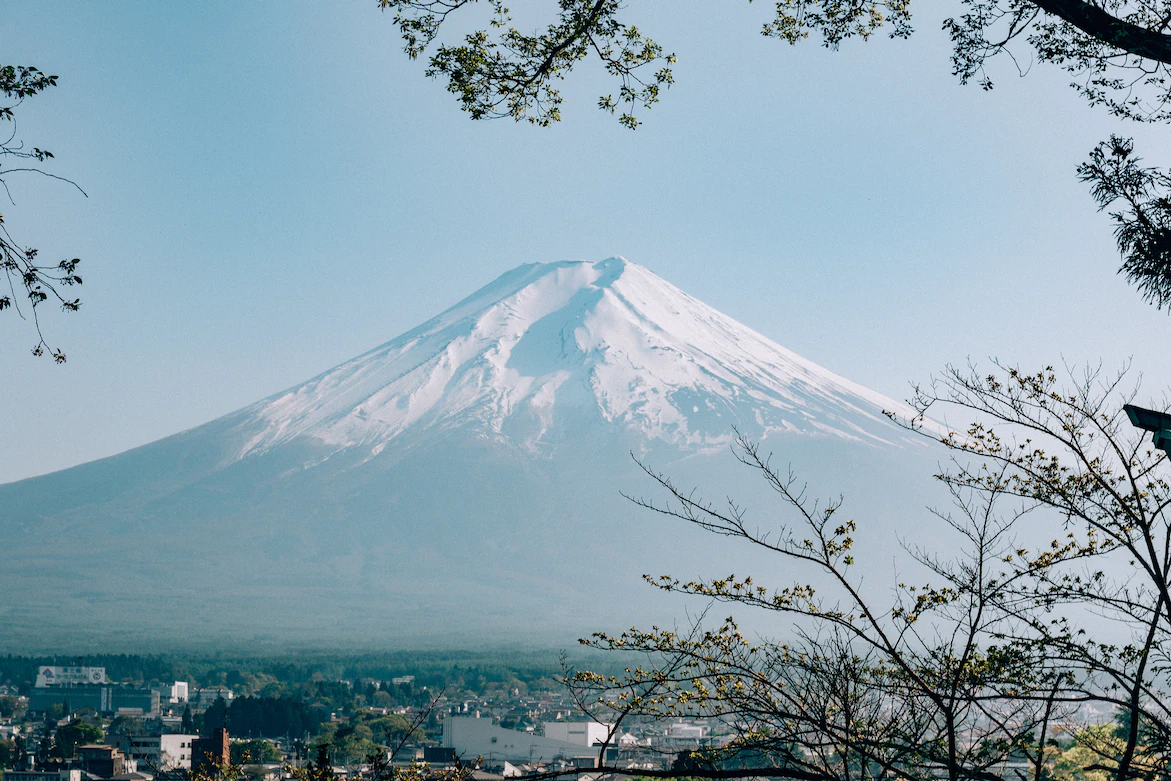
Every day, tens of thousands of travelers cross Shizuoka at 285 km/h, look up from their phones long enough to catch Mount Fuji from the Shinkansen window, and keep going to Kyoto. I understand the impulse. But Shizuoka is the prefecture that actually owns the south face of Fuji, grows the tea you will drink for the rest of your trip, and hides one of Japan’s best hot-spring peninsulas. It is the great Japanese in-between—and stopping here is one of the easiest good decisions a traveler can make.
The key to Shizuoka is to not treat it as one place. It is really three: Fuji’s flank, the tea country, and the Izu Peninsula. Pick the one that matches what you want.
Mount Fuji, From the Side That Matters
Most of the famous Fuji photographs—the ones with the mountain rising behind a torii, a pagoda, or a pine-lined coast—are taken from the Yamanashi side. But Shizuoka offers something Yamanashi cannot: Fuji over the sea.
At Miho no Matsubara, a UNESCO-listed pine grove on a spit of the Pacific coast, the mountain floats above a black-sand beach and a forest of ancient pines. It is the classic composition from Japanese art made real. Inland, Fujinomiya sits at the mountain’s base and holds Fujisan Hongu Sengen Taisha, the head shrine of all Fuji worship and the spiritual starting point of the climb. Nearby, Shiraito Falls—fed entirely by Fuji’s snowmelt seeping through volcanic rock—fans out in dozens of silk-thread streams.
Local truth about Fuji: it is shy. It hides behind cloud for much of summer. Winter mornings are clearest. Check the forecast and be flexible.
Tea Country: Where Your Japanese Green Tea Comes From
Shizuoka grows a large share of Japan’s tea, and the Makinohara Plateau is the heart of it—endless rounded rows of tea bushes rolling to the horizon, with Fuji on the skyline on a clear day. This is not a manicured tourist attraction; it is a working agricultural landscape, which is what makes it beautiful.
Do more than look. Visit during the first harvest (May), join a tea-picking session, or sit for a proper tasting where someone shows you how water temperature changes everything about a cup of sencha. After this, supermarket tea will never taste the same.
Izu Peninsula: The Hot Springs Tokyo Goes To
The Izu Peninsula is Shizuoka’s hot-spring coast, and it is closer to Tokyo than most people realize. Atami, the gateway, is barely 45 minutes from Tokyo by Shinkansen—a hot-spring town that has been in business for a thousand years, perched above the sea. Deeper in, Shuzenji offers a quieter, forested onsen experience around a historic temple, and Shimoda, on the southern tip, pairs hot springs with white-sand beaches and the history of being one of the first Japanese ports opened to the West.
For a first-timer, Izu is the easiest place near Tokyo to do the quintessential Japanese thing properly: stay one night in a ryokan, soak in an outdoor bath, and eat a multi-course seafood dinner in your room.
Eat This
- Sakura shrimp (sakura ebi)—tiny pink shrimp from Suruga Bay, eaten raw, fried, or over rice; Shizuoka is essentially the only place in Japan they’re caught.
- Fresh wasabi—Izu’s clear mountain streams grow real wasabi; try it grated fresh, nothing like the tube paste.
- Shizuoka oden—a darker, distinctive local version of the winter hot-pot, eaten with fish-powder and skewers.
- Green tea everything—from the cup to the ice cream.
Local Tips Most Visitors Miss
- Stop on the way, don’t make a special trip. Shizuoka City is one hour from Tokyo by Shinkansen and sits exactly on the Tokyo–Kyoto line—break your journey here.
- Atami is the low-effort onsen win if you only have one night and want hot springs near Tokyo.
- Clear winter mornings = Fuji. Summer often hides it entirely.
- Rent a car for Izu if you can; the peninsula’s best coast and onsen are awkward by train alone.
- Buy tea at the source—Shizuoka tea makes one of the best, most genuinely Japanese souvenirs.
Practical Info
| Item | Detail |
|---|---|
| Access | Shizuoka Station ~1 hr from Tokyo by Shinkansen; Atami ~45 min |
| Three zones | Fuji flank (Fujinomiya), tea country (Makinohara), Izu Peninsula (onsen) |
| Best time | Winter mornings (Fuji views); May (tea harvest); year-round (onsen) |
| Eat | Sakura shrimp, fresh wasabi, Shizuoka oden, green tea |
| Getting around | Train for cities; rental car recommended for Izu |
Shizuoka is the prefecture that asks for nothing more than a pause. Get off the train you were going to stay on, look at Fuji from the sea, drink tea where it grows, soak in Izu—and the in-between place becomes one of the parts of Japan you remember most.