Ueno presents two faces with unusual directness, and almost no attempt to reconcile them.
On one side of the hill, inside Ueno Park, stands one of the highest concentrations of serious cultural institutions in Asia: the Tokyo National Museum, the National Museum of Nature and Science, the National Museum of Western Art—a Le Corbusier building that is a UNESCO World Heritage Site in its own right—the Tokyo Metropolitan Museum of Art, and the Ueno Zoo. On the other side of the train tracks, packed into the narrow streets around Ameyoko market and the elevated rail structure, are standing bars serving beer and grilled organ meat to people who have been coming here since the 1950s and do not particularly want the neighborhood to change.
Both halves are genuine. Neither half apologizes for the other. This is what makes Ueno, in a city that smooths its contradictions with extraordinary efficiency, one of the few places that still wears them openly.
The Museum Mile: What Ueno Park Actually Contains
The decision to concentrate national cultural institutions in Ueno was not accidental. After the Meiji Restoration of 1868 displaced the Tokugawa shogunate, the new government needed to determine what to do with Kan’ei-ji—the major temple complex that the Tokugawa clan had built here as a spiritual protector of Edo. The answer, after considerable debate, was to convert the temple grounds into Japan’s first Western-style public park in 1873, and then to build the nation’s major museums within it.
This means that several of the museum buildings in Ueno are themselves historically significant, and the collections they hold were assembled, in many cases, from the dispersal of temple treasuries and samurai estates during the early Meiji period. The Tokyo National Museum holds objects that were in private hands for centuries before they were acquired or entrusted to the state. Walking its galleries is an experience of cultural archaeology as much as aesthetic appreciation.
Tokyo National Museum
The Tokyo National Museum (東京国立博物館) is the largest museum in Japan and holds the most comprehensive collection of Japanese art in existence: over 120,000 objects spanning ceramics, lacquerware, metalwork, sculpture, textiles, armor, swords, and screens. The main Honkan building, built in 1938, is itself a notable work of Japanese imperial architecture—a hybrid of Western structure and Japanese roof elements that was the standard aesthetic for public buildings of the era.
For first-time visitors, the permanent collection on the second floor of the Honkan provides the most direct orientation to Japanese art history, organized chronologically from prehistoric Jomon ceramics through the Edo period. The Heiseikan building houses the archaeological collections, including the National Treasures room that holds rotating displays of objects designated as the highest category of Japanese cultural property.
Admission is ¥1,000 for adults. Allow a minimum of two hours; four is more comfortable.
National Museum of Western Art
The National Museum of Western Art (国立西洋美術館) is a building that most visitors to Ueno walk past without fully registering what it is. The original structure—the low horizontal building at the park entrance—was designed by Le Corbusier and completed in 1959. It is one of seventeen Le Corbusier works collectively inscribed as a UNESCO World Heritage Site in 2016, and the only one in Asia.
The building was commissioned by the Japanese government to house the Matsukata Collection—a substantial group of European paintings and sculptures assembled by industrialist Kojiro Matsukata in the early 20th century, seized by the French government during World War II, and returned to Japan on the condition that a public museum be built to display them. Le Corbusier designed the structure according to his principle of the musée à croissance illimitée—a museum of unlimited growth, capable of expanding outward in a spiral from its core.
The permanent collection includes significant works by Rodin (the largest Rodin collection in Asia), Monet, Renoir, and several Dutch and Flemish masters. The building itself—the pilotis, the ramp, the interior light distribution—is worth as much attention as the paintings.
Admission is ¥500 for the permanent collection. The building exterior is visible and photographable for free.
The Other Institutions
The National Museum of Nature and Science (国立科学博物館) is often overlooked in favor of the art museums but holds a remarkable collection of natural history specimens and science exhibits, including a full-size whale skeleton and extensive Japanese dinosaur fossils. The building’s distinctive form—viewed from above, the structure spells out a cross with wings, though this is not legible from the ground—is one of the more unusual pieces of institutional architecture in the park.
The Ueno Zoo (上野動物園), opened in 1882, is Japan’s oldest zoo and the home of the giant panda program that has made it internationally recognizable. The panda enclosures are perpetually crowded; the rest of the zoo is significantly less visited and contains a thoughtful collection maintained with more care than its age might suggest. Entry is ¥600 for adults.
Ueno Park: How to Use It Beyond Museums
The park itself is worth understanding as a piece of urban infrastructure, not just as the container for its institutions.
Shinobazu Pond (不忍池) occupies the southern portion of the park and is one of Tokyo’s most useful recalibration spots—a large natural pond in the center of a dense city, partially covered in lotus plants from June through September, home to a permanent population of cormorants, herons, and various ducks, and orbited by a cycling path and rowing boat rental. The small island in the center holds Bentendo temple, a red lacquered building dedicated to Benzaiten, the goddess of everything that flows: water, time, music, knowledge.
In summer, when the lotus blooms, the pond becomes something genuinely strange and beautiful: a mass of enormous green leaves and pink flowers that makes the urban context around it feel temporary. In winter, the lotus retreats and migratory birds arrive—the cormorants in particular are worth watching, diving and surfacing in a rhythm that seems too efficient to be accidental.
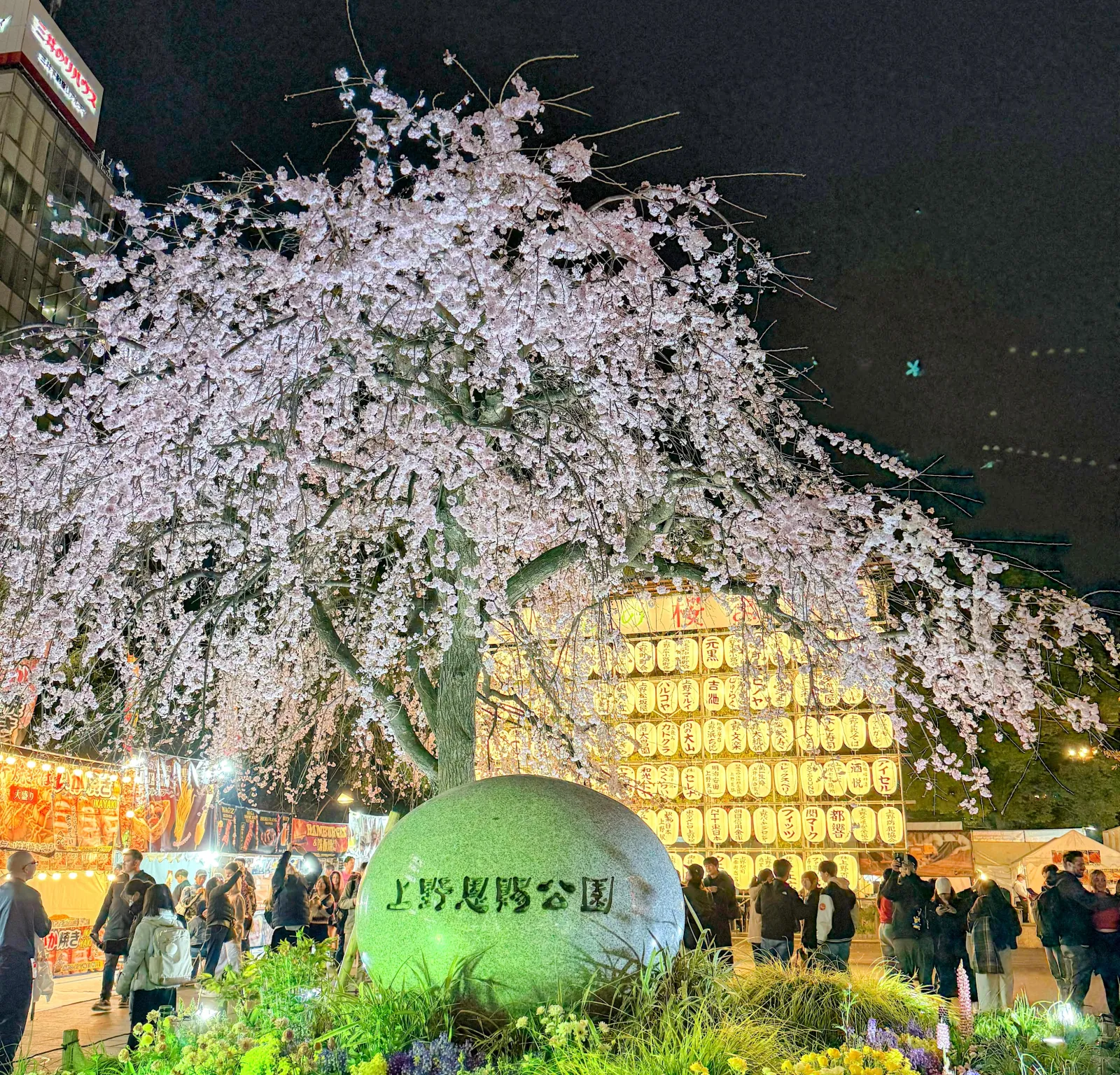
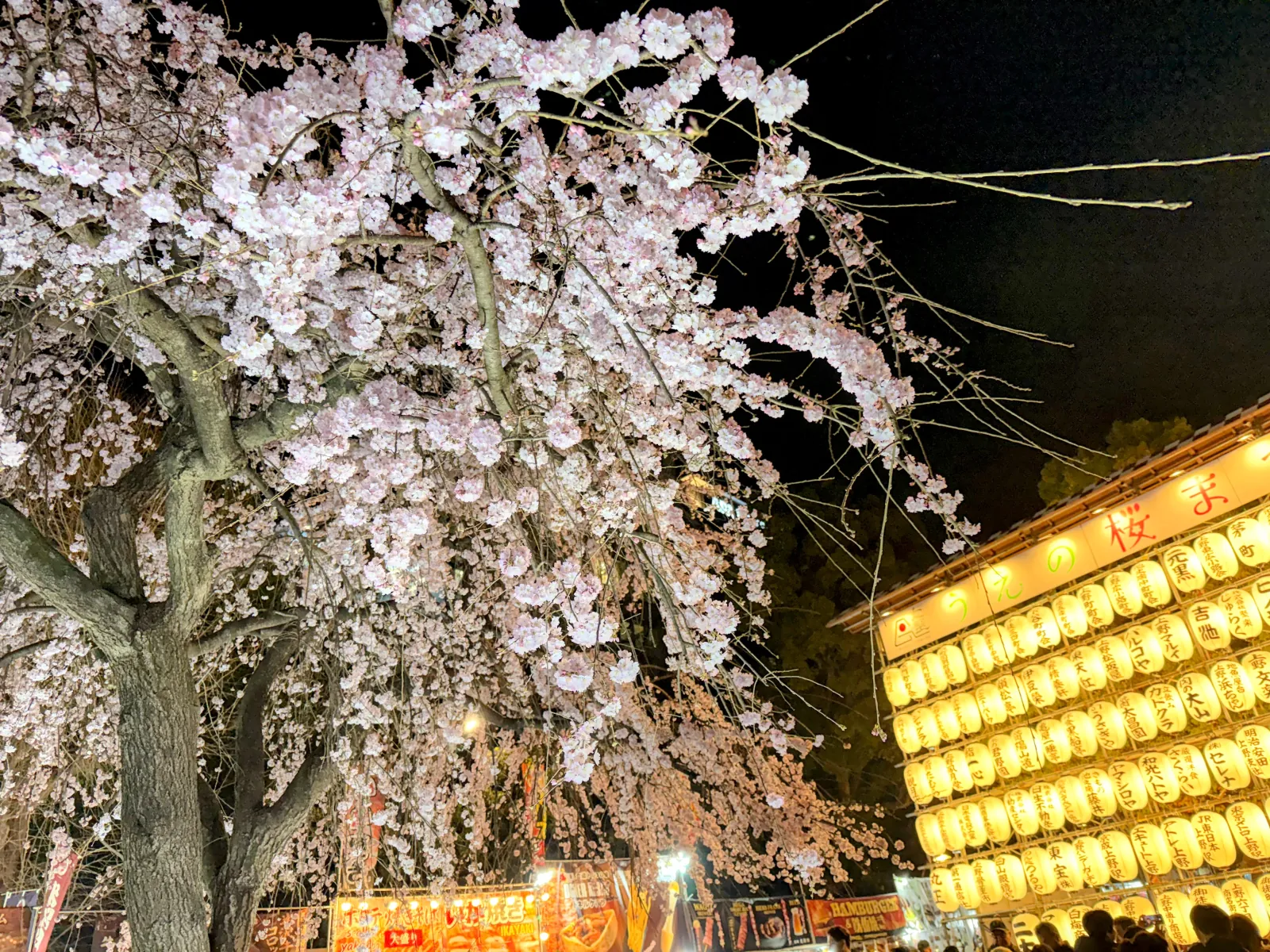
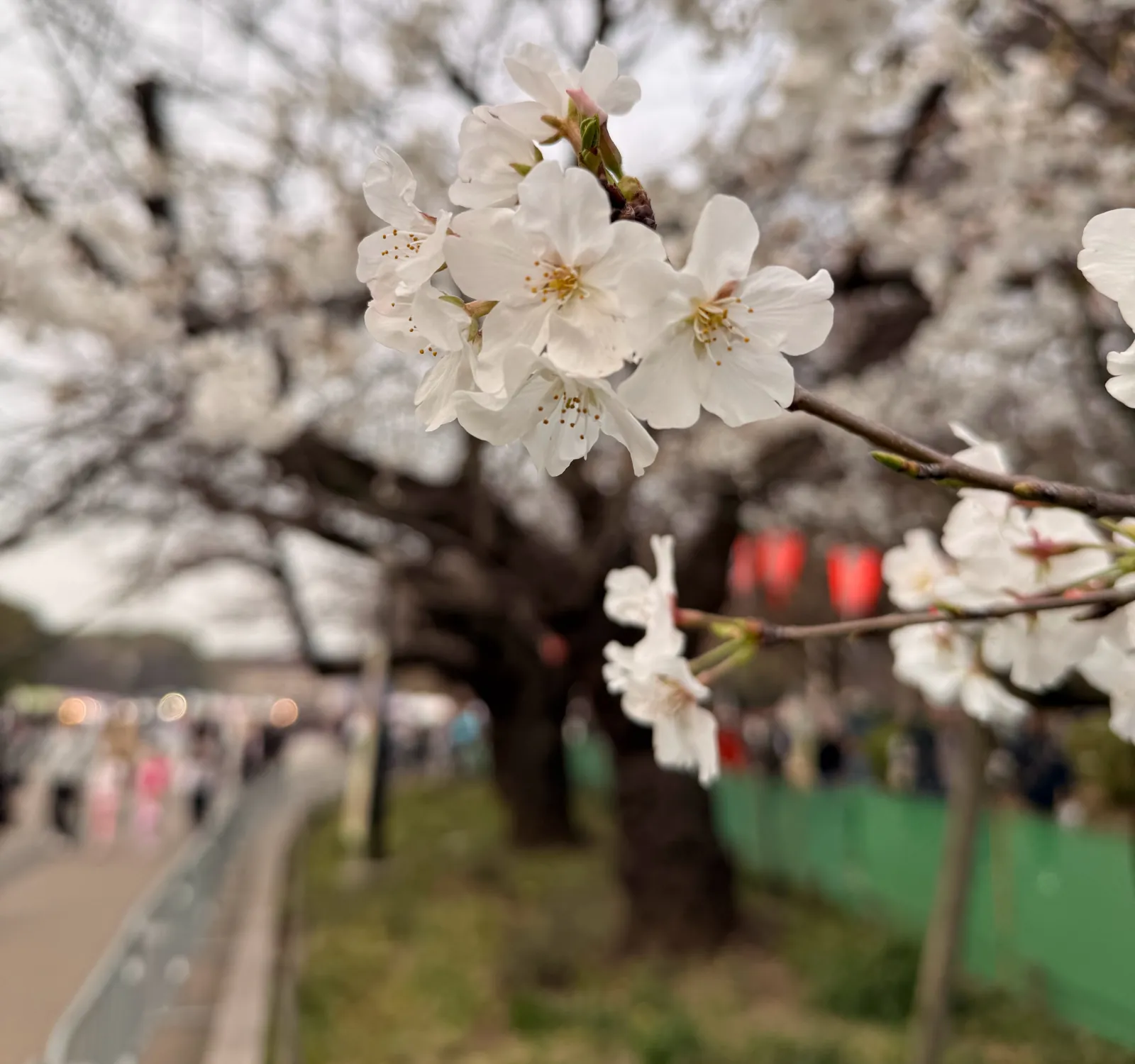
The park’s central avenue—a wide promenade lined with cherry trees—is famous as one of Tokyo’s primary hanami (cherry blossom viewing) sites in late March and early April. During peak bloom, the avenue is occupied from early morning with blue plastic tarps staked out by office workers and groups who have sent the most junior member ahead at 6 AM to hold a spot. The resulting scene is festive, crowded, and entirely characteristic of how Tokyo approaches collective celebration: with planning, dedication, and a great deal of beer.
Ameyoko: The Market That Never Stopped Being Postwar
Ameyoko (アメヤ横丁) is the market street that runs beneath and alongside the elevated tracks between Ueno Station and Okachimachi Station. Its origins are in the postwar black market that occupied this stretch after 1945, when basic goods were scarce and the area under the rail structure became the place where things that were not officially available could be obtained. The market was never fully formalized or regularized; it simply continued, evolved, and persisted into the present.
The contemporary Ameyoko is a compressed experience: dried fish and nuts, fresh seafood displayed on ice outside narrow stalls, discount clothing and shoes, imported cosmetics, street food, and bars that have not materially changed their decor since the Showa era. Vendors call out to passing pedestrians with practiced volume. The smell changes every twenty meters. The width of the main passage is narrow enough that foot traffic slows to a shuffle during peak hours.
It is not a particularly comfortable place to spend time in. That is precisely its value: it is one of the few places in central Tokyo that has not been optimized for the tourist experience, and the resulting texture—genuine commercial activity in a genuinely congested space—is something that planned shopping environments cannot reproduce.
The best time to visit is late afternoon on a weekday, when the fresh seafood counters are doing their pre-dinner business and the bars are beginning to fill with the first round of after-work drinkers.
The Night: Senbero Culture and Gado-shita Bars
The drinking culture in Ueno is organized around a concept called senbero (千ベロ)—a portmanteau of sen (one thousand yen) and bero bero (colloquial Japanese for drunk). The basic premise: a set of drinks and small dishes for roughly ¥1,000. It is not a promotional gimmick but a structural feature of the neighborhood’s bar economy, inherited from the postwar period when the clientele—laborers, market workers, construction workers—needed food and drink at prices that matched their wages.
The bars themselves are mostly small, mostly cash-only, and mostly located either under the elevated rail structure—the gado-shita (高架下) bars—or in the narrow streets immediately adjacent to Ameyoko. The gado-shita bars have the physical quality of the location built into them: low ceilings reinforced against the vibration of passing trains, compact seating arranged around narrow counters, a level of ambient noise that makes them feel livelier than their square footage would suggest.
What to order without consulting a menu: yakitori (charcoal-grilled chicken skewers, order at least the negima and tsukune), motsuyaki (grilled organ meat—the heart and liver skewers are the entry point), and Hoppy. Hoppy is a low-alcohol beer-flavored beverage that dates to 1948 and was developed as an affordable beer substitute during the postwar period. Order it with the correct vocabulary and you will receive a glass mug with ice and shochu (the naka, or inside) and a bottle of Hoppy (the soto, or outside) separately, mixed at the table. When you want more shochu, ask for another naka; when you want more Hoppy, ask for another soto. This is the local protocol and ordering correctly is noticed.
Most of the gado-shita bars do not have English menus. Most of the staff do not speak English. Both of these conditions produce interactions that, handled with patience rather than frustration, are more likely to result in a memorable evening than any equivalent experience in a multilingual tourist bar. Point at what someone else is eating. Use the camera function of a translation app on the handwritten menu boards. Say osusome wa? (what do you recommend?). Someone will respond.
Seasonal Calendar: When Ueno Changes Character
Late March to early April is cherry blossom season, and Ueno Park becomes one of the most famous hanami venues in Tokyo. The park is crowded from morning to late night; the atmosphere is celebratory and loud. The museums continue operating through the season and are, paradoxically, easier to enjoy during blossom week because the outdoor crowds thin the indoor ones.
June through September, the Shinobazu lotus bloom transforms the pond into one of Tokyo’s most photogenic sites. Morning visits before 10 AM, when the light is low and the crowds are absent, produce the best photographs.
November brings the ginkgo trees along the park’s secondary paths into their peak yellow color. Less famous than Meiji Jingu’s ginkgo avenue, but less crowded, and framed differently by the museum buildings.
Winter is when the museums are easiest to enjoy at leisure. Ueno’s indoor institutions—the Tokyo National Museum in particular—are experienced without summer humidity and with fewer visitors. The cold also makes the standing bars warmer in relative terms: a heated gado-shita bar in January, with a mug of Hoppy and a plate of grilled skewers, has an appeal that the same bar in August cannot quite replicate.
Practical Information
- Access: Ueno Station (JR Yamanote Line, Keihin-Tohoku Line; Tokyo Metro Ginza Line, Hibiya Line) — multiple exits for park, museums, and Ameyoko
- Okachimachi Station (JR lines) — southern entrance to Ameyoko, closer to gado-shita bars
- Tokyo National Museum: Tuesday–Sunday, 9:30 AM – 5:00 PM (Fridays and Saturdays until 8:00 PM); closed Mondays; ¥1,000 adults
- National Museum of Western Art: Tuesday–Sunday, 9:30 AM – 5:30 PM (Fridays until 8:00 PM); closed Mondays; ¥500 adults (permanent collection)
- Ueno Zoo: Tuesday–Sunday, 9:30 AM – 5:00 PM; closed Mondays; ¥600 adults
- Ameyoko market: Most stalls open daily, roughly 10:00 AM – 7:00 PM; busiest late afternoon
- Gado-shita bars: Begin filling from around 4:00 PM; peak 6:00–9:00 PM; most cash only