There is a kind of travel Japan does better than almost anywhere: the slow walk toward something sacred. Not a sight you photograph and leave, but a path you put your body on. Wakayama is the home of that experience. On the mountainous Kii Peninsula south of Osaka, it holds two of Japan’s great spiritual landscapes—Mount Koya, a 1,200-year-old monastic city in the clouds, and the Kumano Kodo, a network of pilgrimage trails so old and so revered that they share UNESCO World Heritage status with the Camino de Santiago in Spain.
This is not a prefecture for ticking off attractions. It is a prefecture for staying a few nights and letting the pace change you.
Mount Koya (Koyasan): Sleeping Where the Monks Sleep
In 816, the monk Kukai—known after death as Kobo Daishi, one of the most important figures in Japanese history—founded a monastery on this remote mountaintop. Twelve centuries later, Koyasan is still a working religious community: over 100 temples, the headquarters of Shingon Buddhism, set in a high basin ringed by cedar forest.
The defining Koyasan experience is shukubo—staying overnight in a temple. You sleep on tatami in a monk’s lodging, eat shojin ryori (the refined Buddhist vegetarian cuisine, no meat, no fish, often no garlic), and wake before dawn to sit in on the morning prayer service. There is no equivalent in ordinary tourism. It is the single best way in Japan to step inside a living religious tradition rather than observing it from outside.
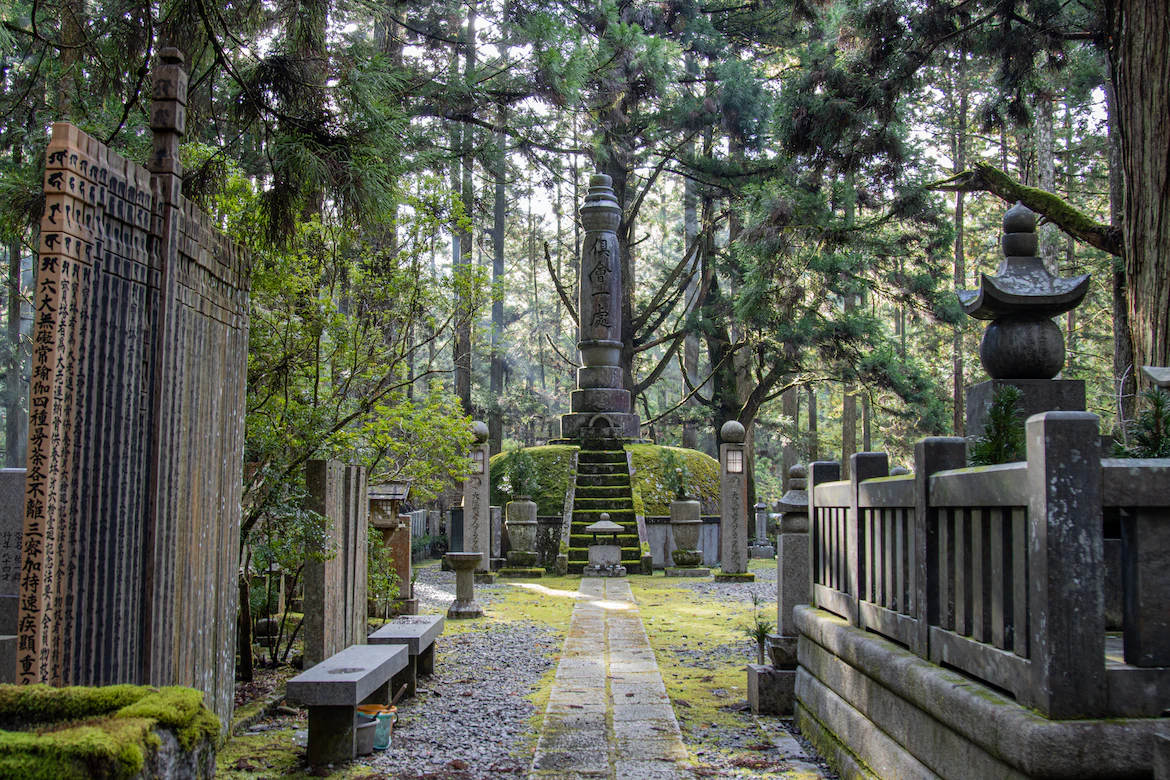
Do not miss Okunoin, the cemetery path leading to Kukai’s mausoleum. Two kilometers of moss-covered stone monuments and towering cedars, more than 200,000 graves of monks, lords, and ordinary people who wished to rest near the saint. Walk it at dusk, when the stone lanterns are lit. Few places in Japan feel this old or this quiet.
The Kumano Kodo: The Pilgrim’s Path
For over a thousand years, emperors and commoners alike walked the Kumano Kodo, a web of trails through the Kii mountains connecting the three grand shrines known as the Kumano Sanzan:
- Kumano Hongu Taisha, the spiritual hub, near the giant Oyunohara torii—the largest shrine gate in the world, standing where the original shrine once sat.
- Kumano Hayatama Taisha, by the Kumano River, the “swift jewel” shrine.
- Kumano Nachi Taisha, set into the mountainside beside the waterfall.
You do not need to be religious or an athlete to walk the Kumano Kodo. You can do a famous short section—like the cobbled Daimon-zaka approach to Nachi—in an hour, or commit to multi-day stretches staying in village inns along the way. The point is the same at any length: this landscape was considered a Pure Land on earth, and walking it is how it was always meant to be understood.
Nachi Falls: Shrine and Waterfall as One
Nachi Falls drops 133 meters in a single plunge—Japan’s tallest waterfall of its kind—and has been worshipped as a deity in its own right since before written history. Beside it stands Kumano Nachi Taisha and the vermilion Seiganto-ji pagoda. The classic view—the three-storied pagoda in the foreground, the white column of water behind—is one of the most photographed scenes in Japan, and one of the few that is even more powerful in person, with the roar of the falls filling the valley.
Local Tips Most Visitors Miss
- Book your temple stay in advance. Koyasan shukubo lodgings fill up, especially in autumn; reserve ahead rather than hoping for a room.
- Give Wakayama 3–4 days. This is a slow region; rushing Koyasan and Kumano into a day trip defeats the purpose.
- Walk at least one Kumano section, even a short one—the trails are the experience, not the shrines alone.
- Dress warm on Koyasan. The mountain is markedly colder than Osaka below, even in summer mornings.
- Spring and autumn are ideal. Summer is humid; winter brings cold and occasional snow at altitude.
Practical Info
| Item | Detail |
|---|---|
| Access | Koyasan ~2 hr from Osaka (Nankai line + cable car); Kumano via Kii-Tanabe or Shingu |
| Must-do | Temple stay (shukubo) on Koyasan; walk a Kumano Kodo section |
| Don’t miss | Okunoin at dusk, Oyunohara torii, Nachi Falls with the pagoda |
| Best time | Spring and autumn; book lodgings early |
| Suggested stay | 3–4 days to do Koyasan and Kumano without rushing |
Wakayama rewards the traveler willing to slow down and walk. Sleep in a temple, rise for prayers, follow a thousand-year-old path through the cedars to a waterfall worshipped as a god—and you will leave understanding something about Japan that no city, however dazzling, can teach you.